


Page 223 - Dynamic Loading and Design of Structures
P. 223
Page 196

                 The purpose of the higher order theory is to approximate more accurately the boundary
               conditions (i.e. the zero normal flow condition at the instantaneous position of the body and
               the pressure condition at the free boundary). Such higher order excitation forces are
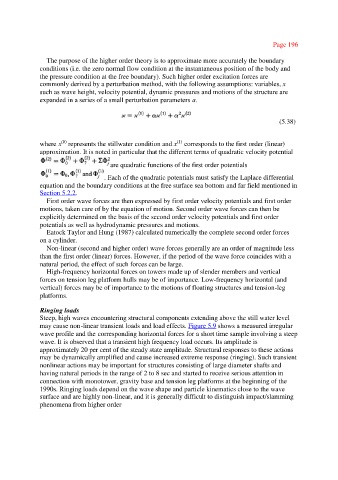
               commonly derived by a perturbation method, with the following assumptions: variables, x
               such as wave height, velocity potential, dynamic pressures and motions of the structure are
               expanded in a series of a small perturbation parameters a.


                                                                                                   (5.38)


                       (0)
               where x represents the stillwater condition and x (1)  corresponds to the first order (linear)
               approximation. It is noted in particular that the different terms of quadratic velocity potential

                                        are quadratic functions of the first order potentials

                                      . Each of the quadratic potentials must satisfy the Laplace differential
               equation and the boundary conditions at the free surface sea bottom and far field mentioned in
               Section 5.2.2.
                 First order wave forces are then expressed by first order velocity potentials and first order
               motions, taken care of by the equation of motion. Second order wave forces can then be
               explicitly determined on the basis of the second order velocity potentials and first order
               potentials as well as hydrodynamic pressures and motions.
                 Eatock Taylor and Hung (1987) calculated numerically the complete second order forces
               on a cylinder.
                 Non-linear (second and higher order) wave forces generally are an order of magnitude less
               than the first order (linear) forces. However, if the period of the wave force coincides with a
               natural period, the effect of such forces can be large.
                 High-frequency horizontal forces on towers made up of slender members and vertical
               forces on tension leg platform hulls may be of importance. Low-frequency horizontal (and
               vertical) forces may be of importance to the motions of floating structures and tension-leg
               platforms.

               Ringing loads
               Steep, high waves encountering structural components extending above the still water level
               may cause non-linear transient loads and load effects. Figure 5.9 shows a measured irregular
               wave profile and the corresponding horizontal forces for a short time sample involving a steep
               wave. It is observed that a transient high frequency load occurs. Its amplitude is
               approximately 20 per cent of the steady state amplitude. Structural responses to these actions
               may be dynamically amplified and cause increased extreme response (ringing). Such transient
               nonlinear actions may be important for structures consisting of large diameter shafts and
               having natural periods in the range of 2 to 8 sec and started to receive serious attention in
               connection with monotower, gravity base and tension leg platforms at the beginning of the
               1990s. Ringing loads depend on the wave shape and particle kinematics close to the wave
               surface and are highly non-linear, and it is generally difficult to distinguish impact/slamming
               phenomena from higher order

