


Page 222 - Dynamic Loading and Design of Structures
P. 222
Page 195

               wave frequencies enhanced by the current, resulting in force components with frequencies
               equal to a difference, sum and double frequencies of the wave components.
                 Components containing the difference frequencies lead to long period forces which may be
               critical for rigid body modes of behaviour. The terms with ω+ω lead to high frequency
                                                                         1
                                                                             2
               forces, which may cause dynamic effects in bottom supported platforms.
                 The non-linearity in Morison’s equation may be linearized to facilitate efficient response
               analysis. Linearization may, for instance, be achieved:
               ●deterministically by requiring that the same energy be dissipated per wave cycle for the
                 linear and non-linear model;
               ●stochastically by assuming that the particle velocity follows a Gaussian distribution and
                 finding the linearization that minimizes the expected mean square error.

               Linearization by consideration of energy dissipation for a single wave-component
               corresponds to taking the first term in the Fourier expansion, eqn (5.32), and ignoring high-
               frequency terms (see e.g. chapter 2, Almar-Næss, 1985). Stochastic linearization of

                         yields                where σis the standard deviation of v(t) (see e.g. Leira,
                                                       v
               1987). Stochastic linearization yields accurate estimates of loads when used to determine
               response variance, which is relevant for fatigue analysis, but needs to be used with caution in
               estimation of extreme values.
                 As mentioned in section 5.2.3, particle velocities and accelerations are Gaussian processes
               in the time domain. In the frequency domain the kinematics is described by spectral densities
               (e.g. eqn (5.23)). The forces (eqn (5.28)) on slender members may also be expressed in the
               frequency domain by the cross-spectral density of the load intensity at two locations m and n.
               This topic is thoroughly treated by Borgman (1972). It is seen that the spectral density has
               peaks at the wave frequency as well as at multiples of the wave frequency as displayed by the
               Fourier expansion, eqns (5.34), (5.35).
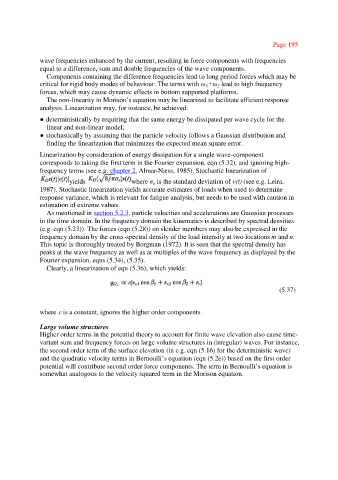
                 Clearly, a linearization of eqn (5.36), which yields:


                                                                                                   (5.37)


               where c is a constant, ignores the higher order components.

               Large volume structures
               Higher order terms in the potential theory to account for finite wave elevation also cause time-
               variant sum and frequency forces on large volume structures in (irregular) waves. For instance,
               the second order term of the surface elevation (in e.g. eqn (5.16) for the deterministic wave)
               and the quadratic velocity terms in Bernoulli’s equation (eqn (5.2e)) based on the first order
               potential will contribute second order force components. The term in Bernoulli’s equation is
               somewhat analogous to the velocity squared term in the Morison equation.

