


Page 218 - Dynamic Loading and Design of Structures
P. 218
Page 191

               can be expressed in a polar co-ordinate system by a product of a function in z and a function
               in r (radial co-ordinate).
                 Once the velocity potential (            ) is known, the pressure on the surface of the
               structure can be calculated from the linearized Bernoulli’s equation (          ) and the
               horizontal and vertical forces may be determined by integrating the pressure.
                 For a vertical cylinder with diameter D=2R, a closed form solution often named the
               MacCamy and Fuchs (1954) approach, can be obtained.
                 The horizontal force q in the x-direction per unit axial length of the cylinder is computed
               as:


                                                                                                   (5.29)


               where                                    ,                                        are the
               derivatives of first order Bessel functions of the first and second kind, respectively.  is the
               volume (     )of the cylinder per unit length. The horizontal force may be expressed in terms
               of an effective inertia coefficient C and a horizontal water particle acceleration component
                                                 M
               a at the centre of the section of the cylinder and at an elevation z corresponding to the inertia
                x
               term of the Morison equation. Hence, ax is given by eqn (5.10). It is noted that the horizontal
               wave force is phase-shifted with respect to the acceleration. It is seen that


                                                                                                   (5.30)


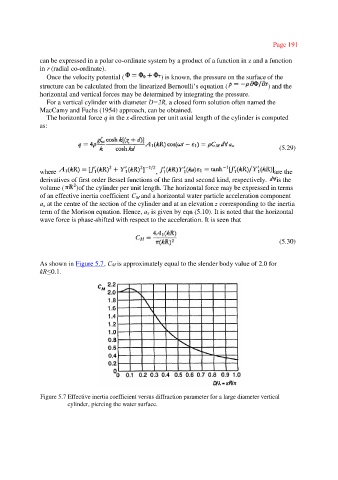
               As shown in Figure 5.7, CM is approximately equal to the slender body value of 2.0 for
               kR≤0.1.


               Figure 5.7 Effective inertia coefficient versus diffraction parameter for a large diameter vertical
                         cylinder, piercing the water surface.

