


Page 219 - Dynamic Loading and Design of Structures
P. 219
Page 192

                 It is noted that the diffraction effects will significantly reduce CM when waves with a period
               of, say, 5 sec act upon columns with a diameter that exceeds 8 m. This issue is important
               when the structure has natural periods around 5 sec.
                 Analytical solutions to several other cases of simple geometry for offshore structures can be
               developed (see e.g. Gran, 1992). These generally require that the member be far removed
               from a boundary, particularly the free surface. Some of these members include spheres,
               horizontal cylinders, bottom seated hemispheres and bottom seated half-cylinders. For more
               complex cases numerical methods have been proposed to obtain wave diffraction solutions.
               These methods include boundary element, finite fluid element, conformal mapping, and
               hybrid techniques. The solutions have received many experimental verifications and practical
               applications (see e.g. Clauss et al., 1991, and Faltinsen, 1990).
                 Wave diffraction solutions do not include viscous actions. When body members are
               relatively slender and have sharp edges, viscous effects may be important and should be
               added to the diffraction forces determined.
                 Wave loads on structures composed of large volume parts and slender members may be
               computed by a combination of wave diffraction theory and Morison’s equation. Parts of the
               structure may be modelled both by boundary elements to represent the potential
               hydrodynamic loads and beams to represent the viscous drag loads. The modifications of
               velocities and accelerations as well as surface elevation (wave enhancement) due to the large
               volume parts should, however, be accounted for when using Morison’s equation. This
               situation may arise in connection with caissons of gravity structures, strong interaction
               between large columns, non-vertical sides near the water plane and other features. The results
               from boundary element methods should be carefully checked for surface-piercing bodies to
               ensure that irregular frequencies are avoided. Moreover, estimates of loads for novel
               structural shapes need to be checked by model tests. Model tests have also been carried out
               systematically to establish Morison-type formulation for inertia forces on gravity structures
               (see e.g. Moan et al. 1976).


                                                5.3.4 Effect of motions

               As mentioned above, when the structure moves, as a result of excitation forces, inertia (added
               mass) and potential damping forces are generated. If the structure moves, the total inertia
               force acting on a slender member of the structure, may then be established as the same FK
               force as that acting on a fixed structure, together with the added mass force associated with
               the relative acceleration between fluid and structure. The drag force may be established by
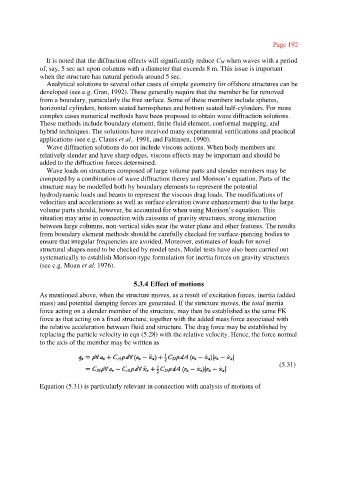
               replacing the particle velocity in eqn (5.28) with the relative velocity. Hence, the force normal
               to the axis of the member may be written as


                                                                                                   (5.31)


               Equation (5.31) is particularly relevant in connection with analysis of motions of

