


Page 213 - Dynamic Loading and Design of Structures
P. 213
Page 186

               mean ergodic processes), each completely described by the spectral density (see definitions in
               Chapter 10). For a given analytical model of the spectrum (e.g. JONSWAP or Pierson—
                                                            ,
               Moskowitz), the spectral parameters Hm0, Tp, γ 0, etc. completely specify the sea state. By
               expressing the magnitude of these parameters and possibly the current and wind velocity and
               direction in probabilistic measures, the long term process is described. For extratropical
               regions, like the North Sea, the joint probability density of the parameters is applied towards
               this aim (see e.g. Haver, 1980). A Weibull distribution is then commonly used to describe the
               marginal distribution of Hm0, while the conditional distribution of Tp given Hm0 is often taken
               to be a log-normal distribution. For tropical areas subject to hurricanes, the long term wave
               climate can be described by storms arriving in a sequence (e.g. Jahns and Wheeler, 1972).
                 Data for the long-term model of the waves can be generated (i) by direct observation of
               wave condition; (ii) hindcasting based on wind data.
                 The probabilistic description of the wave kinematics in terms of the particle velocities and
               accelerations is commonly achieved by applying the principle of superposition of independent
               and arbitrarily distributed disturbances and the Airy or modified Airy wave theory.


                                       5.3 HYDRODYNAMIC LOADING


                                                     5.3.1 General
               In general, the effects of waves and currents on marine structures are obtained as vector
               superposition of all forces on the individual structural elements. If relevant, the subsequent
               response (e.g. the motion of the structure) also needs to be considered. To calculate
               hydrodynamic forces, it is necessary to integrate the pressure field over the wetted surface of
               the structure. The main force components are (Clauss et al., 1991; Faltinsen, 1990):

               ●Froude-Krylov force—pressure effects due to undisturbed incident waves;
               ●hydrodynamic ‘added’ mass and potential damping force—pressure effects due to relative
                 acceleration and velocity between water particles and structural components in an ideal
                 fluid;
               ●viscous drag force—pressure effect due to relative velocity between water particles and
                 structural components.

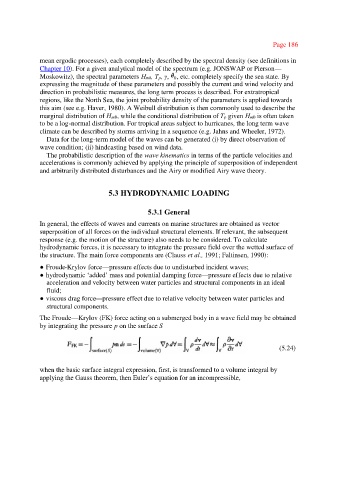
               The Froude—Krylov (FK) force acting on a submerged body in a wave field may be obtained
               by integrating the pressure p on the surface S


                                                                                                   (5.24)


               when the basic surface integral expression, first, is transformed to a volume integral by
               applying the Gauss theorem, then Euler’s equation for an incompressible,

