


Page 210 - Dynamic Loading and Design of Structures
P. 210
Page 183

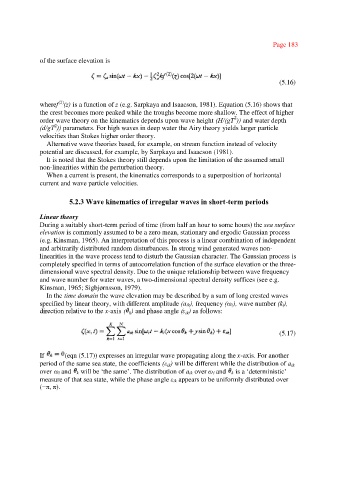
               of the surface elevation is


                                                                                                   (5.16)


                      (2)
               wheref (z) is a function of z (e.g. Sarpkaya and Isaacson, 1981). Equation (5.16) shows that
               the crest becomes more peaked while the troughs become more shallow. The effect of higher
                                                                                   2
               order wave theory on the kinematics depends upon wave height (H/(gT )) and water depth
                    2
               (d/gT )) parameters. For high waves in deep water the Airy theory yields larger particle
               velocities than Stokes higher order theory.
                 Alternative wave theories based, for example, on stream function instead of velocity
               potential are discussed, for example, by Sarpkaya and Isaacson (1981).
                 It is noted that the Stokes theory still depends upon the limitation of the assumed small
               non-linearities within the perturbation theory.
                 When a current is present, the kinematics corresponds to a superposition of horizontal
               current and wave particle velocities.


                         5.2.3 Wave kinematics of irregular waves in short-term periods


               Linear theory
               During a suitably short-term period of time (from half an hour to some hours) the sea surface
               elevation is commonly assumed to be a zero mean, stationary and ergodic Gaussian process
               (e.g. Kinsman, 1965). An interpretation of this process is a linear combination of independent
               and arbitrarily distributed random disturbances. In strong wind generated waves non-
               linearities in the wave process tend to disturb the Gaussian character. The Gaussian process is
               completely specified in terms of autocorrelation function of the surface elevation or the three-
               dimensional wave spectral density. Due to the unique relationship between wave frequency
               and wave number for water waves, a two-dimensional spectral density suffices (see e.g.
               Kinsman, 1965; Sigbjørnsson, 1979).
                 In the time domain the wave elevation may be described by a sum of long crested waves
               specified by linear theory, with different amplitude (aik), frequency (ω i), wave number (ki),
               direction relative to the x-axis ( ) and phase angle (ε) as follows:
                                              k
                                                                  ik

                                                                                                   (5.17)


               If       (eqn (5.17)) expresses an irregular wave propagating along the x-axis. For another
               period of the same sea state, the coefficients (ε) will be different while the distribution of a ik
                                                            ik
               over ω i and  k will be ‘the same’. The distribution of aik over ω i and  k is a ‘deterministic’
               measure of that sea state, while the phase angle ε ik appears to be uniformly distributed over
                  ,
                     )
               (−ππ.

