


Page 212 - Dynamic Loading and Design of Structures
P. 212
Page 185

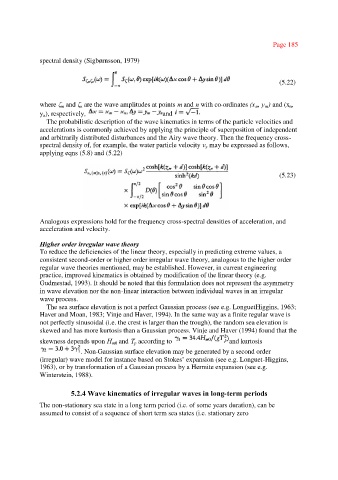
               spectral density (Sigbørnsson, 1979)


                                                                                                   (5.22)


               where ζand ζare the wave amplitudes at points m and n with co-ordinates (x , y ) and (x ,
                                                                                                       n
                      m
                                                                                           m
                             n
                                                                                              m
               y ), respectively,                         and
                n
                 The probabilistic description of the wave kinematics in terms of the particle velocities and
               accelerations is commonly achieved by applying the principle of superposition of independent
               and arbitrarily distributed disturbances and the Airy wave theory. Then the frequency cross-
               spectral density of, for example, the water particle velocity v may be expressed as follows,
                                                                         x
               applying eqns (5.8) and (5.22)

                                                                                                   (5.23)


               Analogous expressions hold for the frequency cross-spectral densities of acceleration, and
               acceleration and velocity.


               Higher order irregular wave theory
               To reduce the deficiencies of the linear theory, especially in predicting extreme values, a
               consistent second-order or higher order irregular wave theory, analogous to the higher order
               regular wave theories mentioned, may be established. However, in current engineering
               practice, improved kinematics is obtained by modification of the linear theory (e.g.
               Gudmestad, 1993). It should be noted that this formulation does not represent the asymmetry
               in wave elevation nor the non-linear interaction between individual waves in an irregular
               wave process.
                 The sea surface elevation is not a perfect Gaussian process (see e.g. LonguetHiggins, 1963;
               Haver and Moan, 1983; Vinje and Haver, 1994). In the same way as a finite regular wave is
               not perfectly sinusoidal (i.e. the crest is larger than the trough), the random sea elevation is
               skewed and has more kurtosis than a Gaussian process. Vinje and Haver (1994) found that the
               skewness depends upon H  m0  and T according to                    and kurtosis
                                                p
                             . Non-Gaussian surface elevation may be generated by a second order
               (irregular) wave model for instance based on Stokes’ expansion (see e.g. Longuet-Higgins,
               1963), or by transformation of a Gaussian process by a Hermite expansion (see e.g.
               Winterstein, 1988).


                          5.2.4 Wave kinematics of irregular waves in long-term periods

               The non-stationary sea state in a long term period (i.e. of some years duration), can be
               assumed to consist of a sequence of short term sea states (i.e. stationary zero

