


Page 225 - Dynamic Loading and Design of Structures
P. 225
Page 198


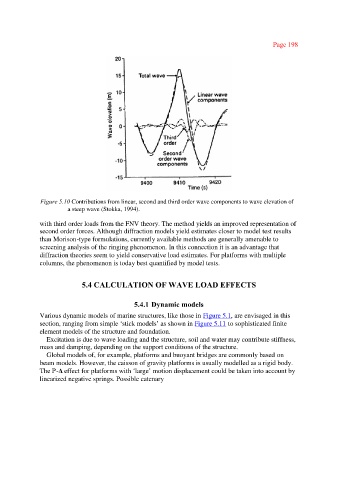
               Figure 5.10 Contributions from linear, second and third order wave components to wave elevation of
                         a steep wave (Stokka, 1994).

               with third order loads from the FNV theory. The method yields an improved representation of
               second order forces. Although diffraction models yield estimates closer to model test results
               than Morison-type formulations, currently available methods are generally amenable to
               screening analysis of the ringing phenomenon. In this connection it is an advantage that
               diffraction theories seem to yield conservative load estimates. For platforms with multiple
               columns, the phenomenon is today best quantified by model tests.


                              5.4 CALCULATION OF WAVE LOAD EFFECTS


                                                5.4.1 Dynamic models
               Various dynamic models of marine structures, like those in Figure 5.1, are envisaged in this
               section, ranging from simple ‘stick models’ as shown in Figure 5.11 to sophisticated finite
               element models of the structure and foundation.
                 Excitation is due to wave loading and the structure, soil and water may contribute stiffness,
               mass and damping, depending on the support conditions of the structure.
                 Global models of, for example, platforms and buoyant bridges are commonly based on
               beam models. However, the caisson of gravity platforms is usually modelled as a rigid body.
               The P-Δeffect for platforms with ‘large’ motion displacement could be taken into account by
               linearized negative springs. Possible catenary

