


Page 229 - Dynamic Loading and Design of Structures
P. 229
Page 202

                 In particular the assessment of damping and soil stiffness is susceptible to significant
               uncertainties. Hence, in-service measurements are useful to justify the assumptions made in
               design analyses. Hoen et al. (1991, 1993), for instance, show that the (total) modal damping
               ratios are about 2 per cent for the first three modes of gravity platforms. Karunakaran et al.
               (1997) found total damping ratios between 0.6 and 1.5 per cent for a jacket with natural
               periods around 1 sec. These references also provide information about assumed versus
               observed soil stiffness.


                                              5.4.2 Equations of motion
               Equations of motion may be formulated in the time or frequency domain (see e.g. Clough and
               Penzien (1993)). The choice of formulation depends especially on possible

               ●frequency dependence
               ●non-linearities

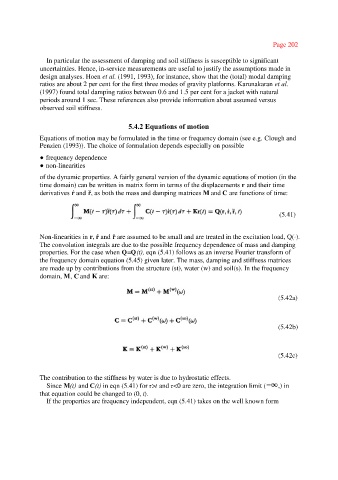
               of the dynamic properties. A fairly general version of the dynamic equations of motion (in the
               time domain) can be written in matrix form in terms of the displacements r and their time
               derivatives ŕand řas both the mass and damping matrices M and C are functions of time:
                                 ,


                                                                                                   (5.41)


               Non-linearities in r, ŕand řare assumed to be small and are treated in the excitation load, Q(·).
               The convolution integrals are due to the possible frequency dependence of mass and damping
               properties. For the case when Q=Q(t), eqn (5.41) follows as an inverse Fourier transform of
               the frequency domain equation (5.45) given later. The mass, damping and stiffness matrices
               are made up by contributions from the structure (st), water (w) and soil(s). In the frequency
               domain, M, C and K are:


                                                                                                   (5.42a)


                                                                                                   (5.42b)


                                                                                                   (5.42c)


               The contribution to the stiffness by water is due to hydrostatic effects.
                 Since M(t) and C(t) in eqn (5.41) for τt and τ0 are zero, the integration limit (  ,) in
                                                      >
                                                              <
               that equation could be changed to (0, t).
                 If the properties are frequency independent, eqn (5.41) takes on the well known form

