


Page 231 - Dynamic Loading and Design of Structures
P. 231
Page 203

               (1) the retardation time for mass and for damping are so short that the time dependent
                 properties are Dirac delta functions;
               (2) the response is narrow-banded.
               In practice the frequency dependent mass and damping properties are chosen to be the values
               corresponding to the peak frequency ω p of the wave spectral density. Langen (1981) found
               that the error in the response of floating bridges by approxi-mating mass and damping by their
               values at the wave spectral peak was less than 5 to 6 per cent.
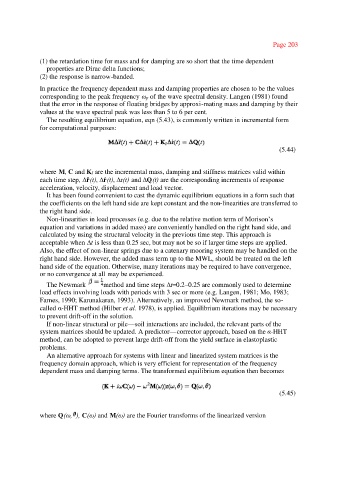
                 The resulting equilibrium equation, eqn (5.43), is commonly written in incremental form
               for computational purposes:


                                                                                                   (5.44)


               where M, C and KI are the incremental mass, damping and stiffness matrices valid within
                                           r
                                       (
               each time step, ∆řt), ∆ŕt), ∆(t) and ∆Q(t) are the corresponding increments of response
                                 (
               acceleration, velocity, displacement and load vector.
                 It has been found convenient to cast the dynamic equilibrium equations in a form such that
               the coefficients on the left hand side are kept constant and the non-linearities are transferred to
               the right hand side.
                 Non-linearities in load processes (e.g. due to the relative motion term of Morison’s
               equation and variations in added mass) are conveniently handled on the right hand side, and
               calculated by using the structural velocity in the previous time step. This approach is
                                 t
               acceptable when ∆ is less than 0.25 sec, but may not be so if larger time steps are applied.
               Also, the effect of non-linear springs due to a catenary mooring system may be handled on the
               right hand side. However, the added mass term up to the MWL, should be treated on the left
               hand side of the equation. Otherwise, many iterations may be required to have convergence,
               or no convergence at all may be experienced.

                 The Newmark         method and time steps ∆=0.2–0.25 are commonly used to determine
                                                             t
               load effects involving loads with periods with 3 sec or more (e.g. Langen, 1981; Mo, 1983;
               Farnes, 1990; Karunakaran, 1993). Alternatively, an improved Newmark method, the so-
                       -
               called αHHT method (Hilber et al. 1978), is applied. Equilibrium iterations may be necessary
               to prevent drift-off in the solution.
                 If non-linear structural or pile—soil interactions are included, the relevant parts of the
                                                                                                -
               system matrices should be updated. A predictor—corrector approach, based on the αHHT
               method, can be adopted to prevent large drift-off from the yield surface in elastoplastic
               problems.
                 An alternative approach for systems with linear and linearized system matrices is the
               frequency domain approach, which is very efficient for representation of the frequency
               dependent mass and damping terms. The transformed equilibrium equation then becomes


                                                                                                   (5.45)


                                  )
                          ,
                                            )
               where Q(ω ), C(ω and M(ω are the Fourier transforms of the linearized version

