


Page 234 - Dynamic Loading and Design of Structures
P. 234
Page 206

               and S ζ (ω is the autospectral density of the sea elevation. F(ω) is obtained by integrating the
                        )
               hydrodynamic load intensity over pairs of finite elements to produce pairs of nodal forces and
               adding them to the global spectrum matrix.
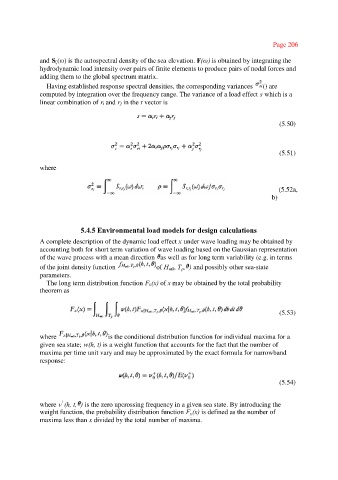
                 Having established response spectral densities, the corresponding variances  () are
               computed by integration over the frequency range. The variance of a load effect s which is a
               linear combination of ri and rj in the r vector is


                                                                                                   (5.50)


                                                                                                   (5.51)

               where


                                                                                                   (5.52a,
                                                                                                 b)


                             5.4.5 Environmental load models for design calculations
               A complete description of the dynamic load effect x under wave loading may be obtained by
               accounting both for short term variation of wave loading based on the Gaussian representation
               of the wave process with a mean direction as well as for long term variability (e.g. in terms
               of the joint density function            of H , T , ) and possibly other sea-state
                                                                 p
                                                            m0
               parameters.
                 The long term distribution function Fx(x) of x may be obtained by the total probability
               theorem as


                                                                                                   (5.53)


               where                   is the conditional distribution function for individual maxima for a
               given sea state; w(h, t) is a weight function that accounts for the fact that the number of
               maxima per time unit vary and may be approximated by the exact formula for narrowband
               response:


                                                                                                   (5.54)


                       +
               where v (h, t, ) is the zero upcrossing frequency in a given sea state. By introducing the
               weight function, the probability distribution function F (x) is defined as the number of
                                                                    x
               maxima less than x divided by the total number of maxima.

