


Page 232 - Dynamic Loading and Design of Structures
P. 232
Page 204

               of the time domain counterparts in eqn (5.41). The first term may be regarded as a complex
                                                                             ,
                                                                           (
               transfer function relating force amplitude to wave amplitude ζω ) for a harmonic wave with
               frequency ωand a main wave direction .

                                             5.4.3 Time domain analyses
               Time Domain Analysis (TDA) is only of interest when, for example, non-linearities make a
               linearized frequency domain approach inaccurate or when a Frequency Domain Approach
               (FDA) which incorporates the non-linear features is very time consuming. The TDA is not
               attractive compared with the FDA when the behaviour is linear. This is because it implies a
               sampling uncertainty which will not be present in the FDA. Moreover, TDA is more time
               consuming than the FDA especially when frequency dependent dynamic properties need to be
               accounted for according to eqn (5.41). TDA may be performed with deterministic or
               probabilistic models of wave loading, as further discussed in Section 5.4.5.
                 The present discussion refers to TDA of systems with non-linear behaviour subjected to
               stochastic loading. In general, the load effects need to be calculated for all or representative
               sea states over a long term period for each sea state described by a wave spectrum (eqns
               (5.19) and (5.20)). Equation (5.43) is then solved by applying a number of load process
               samples which are generated by Monte Carlo simulation.
                                                                                      T
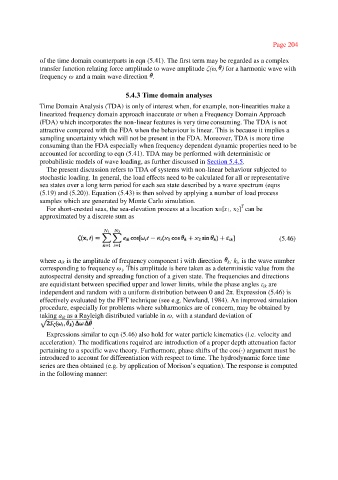
                 For short-crested seas, the sea-elevation process at a location x=[x 1, x2] can be
               approximated by a discrete sum as


                                                                                                   (5.46)


               where aik is the amplitude of frequency component i with direction  k; ki, is the wave number
               corresponding to frequency ω. This amplitude is here taken as a deterministic value from the
                                            i
               autospectral density and spreading function of a given state. The frequencies and directions
               are equidistant between specified upper and lower limits, while the phase angles εare
                                                                                              ik
               independent and random with a uniform distribution between 0 and 2πExpression (5.46) is
                                                                                   .
               effectively evaluated by the FFT technique (see e.g. Newland, 1984). An improved simulation
               procedure, especially for problems where subharmonics are of concern, may be obtained by
               taking a as a Rayleigh distributed variable in ω with a standard deviation of
                                                              ,
                       ik
                                  .
                 Expressions similar to eqn (5.46) also hold for water particle kinematics (i.e. velocity and
               acceleration). The modifications required are introduction of a proper depth attenuation factor
               pertaining to a specific wave theory. Furthermore, phase shifts of the cos(·) argument must be
               introduced to account for differentiation with respect to time. The hydrodynamic force time
               series are then obtained (e.g. by application of Morison’s equation). The response is computed
               in the following manner:

