


Page 237 - Dynamic Loading and Design of Structures
P. 237
Page 208

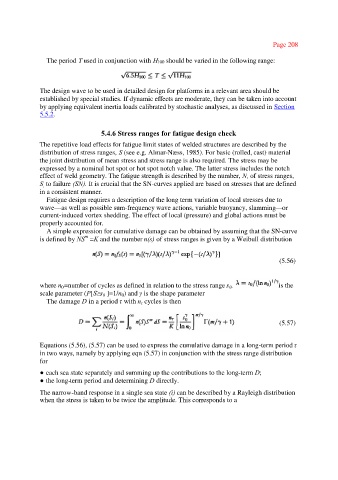
                 The period T used in conjunction with H100 should be varied in the following range:


               The design wave to be used in detailed design for platforms in a relevant area should be
               established by special studies. If dynamic effects are moderate, they can be taken into account
               by applying equivalent inertia loads calibrated by stochastic analyses, as discussed in Section
               5.5.2.


                                     5.4.6 Stress ranges for fatigue design check

               The repetitive load effects for fatigue limit states of welded structures are described by the
               distribution of stress ranges, S (see e.g. Almar-Næss, 1985). For basic (rolled, cast) material
               the joint distribution of mean stress and stress range is also required. The stress may be
               expressed by a nominal hot spot or hot spot notch value. The latter stress includes the notch
               effect of weld geometry. The fatigue strength is described by the number, N, of stress ranges,
               S to failure (SN). It is crucial that the SN-curves applied are based on stresses that are defined
                ,
               in a consistent manner.
                 Fatigue design requires a description of the long term variation of local stresses due to
               wave—as well as possible sum-frequency wave actions, variable buoyancy, slamming—or
               current-induced vortex shedding. The effect of local (pressure) and global actions must be
               properly accounted for.
                 A simple expression for cumulative damage can be obtained by assuming that the SN-curve
                               m
               is defined by NS =K and the number n(s) of stress ranges is given by a Weibull distribution


                                                                                                   (5.56)


               where n =number of cycles as defined in relation to the stress range s ,            is the
                       0
                                                                                  0
                                    s
                                                    i
               scale parameter (P[S≥ ]=1/n ) and γs the shape parameter
                                            0
                                     0
                 The damage D in a period τwith n cycles is then
                                                   τ
                                                                                                   (5.57)

               Equations (5.56), (5.57) can be used to express the cumulative damage in a long-term period τ
               in two ways, namely by applying eqn (5.57) in conjunction with the stress range distribution
               for

               ●each sea state separately and summing up the contributions to the long-term D;
               ●the long-term period and determining D directly.

               The narrow-band response in a single sea state (i) can be described by a Rayleigh distribution
               when the stress is taken to be twice the amplitude. This corresponds to a

