


Page 240 - Dynamic Loading and Design of Structures
P. 240
Page 211


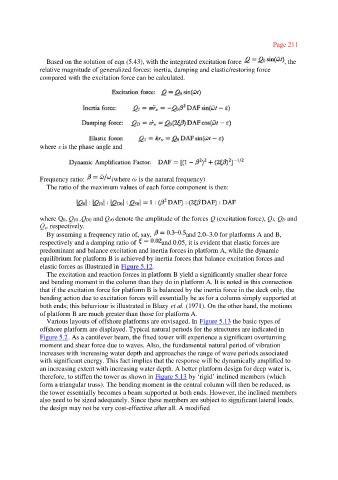
                 Based on the solution of eqn (5.43), with the integrated excitation force           , the
               relative magnitude of generalized forces: inertia, damping and elastic/restoring force
               compared with the excitation force can be calculated.


                       i
               where εs the phase angle and


               Frequency ratio:         (where ωis the natural frequency)
                 The ratio of the maximum values of each force component is then:


               where Q0, QI0 ,QD0 and Qs0 denote the amplitude of the forces Q (excitation force), QI, QD and
               Q , respectively.
                 s
                 By assuming a frequency ratio of, say,           and 2.0–3.0 for platforms A and B,
               respectively and a damping ratio of        and 0.05, it is evident that elastic forces are
               predominant and balance excitation and inertia forces in platform A, while the dynamic
               equilibrium for platform B is achieved by inertia forces that balance excitation forces and
               elastic forces as illustrated in Figure 5.12.
                 The excitation and reaction forces in platform B yield a significantly smaller shear force
               and bending moment in the column than they do in platform A. It is noted in this connection
               that if the excitation force for platform B is balanced by the inertia force in the deck only, the
               bending action due to excitation forces will essentially be as for a column simply supported at
               both ends; this behaviour is illustrated in Blazy et al. (1971). On the other hand, the motions
               of platform B are much greater than those for platform A.
                 Various layouts of offshore platforms are envisaged. In Figure 5.13 the basic types of
               offshore platform are displayed. Typical natural periods for the structures are indicated in
               Figure 5.2. As a cantilever beam, the fixed tower will experience a significant overturning
               moment and shear force due to waves. Also, the fundamental natural period of vibration
               increases with increasing water depth and approaches the range of wave periods associated
               with significant energy. This fact implies that the response will be dynamically amplified to
               an increasing extent with increasing water depth. A better platform design for deep water is,
               therefore, to stiffen the tower as shown in Figure 5.13 by ‘rigid’ inclined members (which
               form a triangular truss). The bending moment in the central column will then be reduced, as
               the tower essentially becomes a beam supported at both ends. However, the inclined members
               also need to be sized adequately. Since these members are subject to significant lateral loads,
               the design may not be very cost-effective after all. A modified

