


Page 243 - Dynamic Loading and Design of Structures
P. 243
Page 214


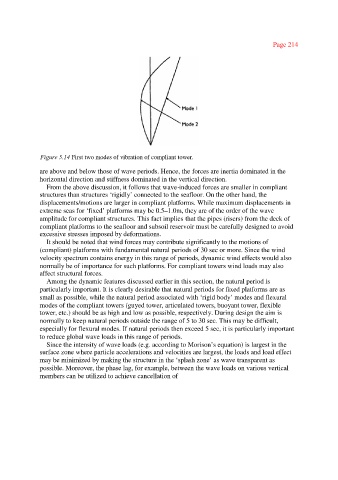
               Figure 5.14 First two modes of vibration of compliant tower.

               are above and below those of wave periods. Hence, the forces are inertia dominated in the
               horizontal direction and stiffness dominated in the vertical direction.
                 From the above discussion, it follows that wave-induced forces are smaller in compliant
               structures than structures ‘rigidly’ connected to the seafloor. On the other hand, the
               displacements/motions are larger in compliant platforms. While maximum displacements in
               extreme seas for ‘fixed’ platforms may be 0.5–1.0m, they are of the order of the wave
               amplitude for compliant structures. This fact implies that the pipes (risers) from the deck of
               compliant platforms to the seafloor and subsoil reservoir must be carefully designed to avoid
               excessive stresses imposed by deformations.
                 It should be noted that wind forces may contribute significantly to the motions of
               (compliant) platforms with fundamental natural periods of 30 sec or more. Since the wind
               velocity spectrum contains energy in this range of periods, dynamic wind effects would also
               normally be of importance for such platforms. For compliant towers wind loads may also
               affect structural forces.
                 Among the dynamic features discussed earlier in this section, the natural period is
               particularly important. It is clearly desirable that natural periods for fixed platforms are as
               small as possible, while the natural period associated with ‘rigid body’ modes and flexural
               modes of the compliant towers (guyed tower, articulated towers, buoyant tower, flexible
               tower, etc.) should be as high and low as possible, respectively. During design the aim is
               normally to keep natural periods outside the range of 5 to 30 sec. This may be difficult,
               especially for flexural modes. If natural periods then exceed 5 sec, it is particularly important
               to reduce global wave loads in this range of periods.
                 Since the intensity of wave loads (e.g. according to Morison’s equation) is largest in the
               surface zone where particle accelerations and velocities are largest, the loads and load effect
               may be minimized by making the structure in the ‘splash zone’ as wave transparent as
               possible. Moreover, the phase lag, for example, between the wave loads on various vertical
               members can be utilized to achieve cancellation of

