


Page 228 - Dynamic Loading and Design of Structures
P. 228
Page 201

                 If the soil or rock is activated during the vibration, it will contribute radiation and hysteretic
               (material) damping. Soil damping for (embedded) plate and pile foundations is discussed, for
               example, by Moan et al. (1976), Barltrop and Adams (1991), Wolf (1994). Soil damping,
               especially in rocking motion, is frequency dependent. If a non-linear soil model is used, the
               hysteric damping will be implicitly included in the analysis.
                 If the damping of the structure or the soil is given with reference to a pure structural or
               foundation mode of vibration, the damping should be appropriately modified when it is
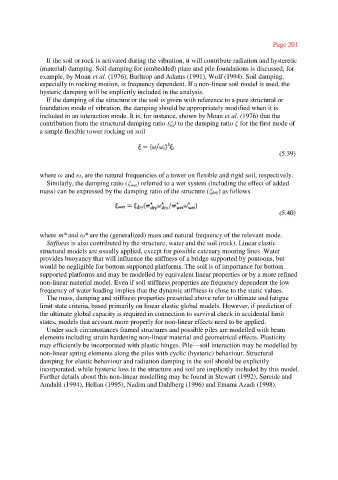
               included in an interaction mode. It is, for instance, shown by Moan et al. (1976) that the
                                                              )
               contribution from the structural damping ratio (ξ to the damping ratio ξfor the first mode of
                                                              s
               a simple flexible tower rocking on soil


                                                                                                   (5.39)


               where ωand ω are the natural frequencies of a tower on flexible and rigid soil, respectively.
                              s
                 Similarly, the damping ratio (ξ ) referred to a wet system (including the effect of added
                                               wet
               mass) can be expressed by the damping ratio of the structure (ξ dry) as follows


                                                                                                   (5.40)


               where m* and ω* are the (generalized) mass and natural frequency of the relevant mode.
                 Stiffness is also contributed by the structure, water and the soil (rock). Linear elastic
               structural models are usually applied, except for possible catenary mooring lines. Water
               provides buoyancy that will influence the stiffness of a bridge supported by pontoons, but
               would be negligible for bottom supported platforms. The soil is of importance for bottom
               supported platforms and may be modelled by equivalent linear properties or by a more refined
               non-linear material model. Even if soil stiffness properties are frequency dependent the low
               frequency of water loading implies that the dynamic stiffness is close to the static values.
                 The mass, damping and stiffness properties presented above refer to ultimate and fatigue
               limit state criteria, based primarily on linear elastic global models. However, if prediction of
               the ultimate global capacity is required in connection to survival check in accidental limit
               states, models that account more properly for non-linear effects need to be applied.
                 Under such circumstances framed structures and possible piles are modelled with beam
               elements including strain hardening non-linear material and geometrical effects. Plasticity
               may efficiently be incorporated with plastic hinges. Pile—soil interaction may be modelled by
               non-linear spring elements along the piles with cyclic (hysteric) behaviour. Structural
               damping for elastic behaviour and radiation damping in the soil should be explicitly
               incorporated, while hysteric loss in the structure and soil are implicitly included by this model.
               Further details about this non-linear modelling may be found in Stewart (1992), Søreide and
               Amdahl (1994), Hellan (1995), Nadim and Dahlberg (1996) and Emami Azadi (1998).

