


Page 140 - Dynamic Vision for Perception and Control of Motion
P. 140
124       5  Extraction of Visual Features


            terpretation process. So, the amount of image data to be touched is reduced drasti-
            cally, while background knowledge on the object/subject class allows asking spe-
            cific questions in image interpretation with correspondingly tuned feature extrac-
            tors. Continuity conditions  over time play  an important role in state estimation
            from image data. In a complex scene, many of these questions have to be answered
            in parallel during each video cycle. This can be achieved by time slicing attention
            of a single processor/software combination or by operating with several or many
            processors (maybe with special software packages) in parallel. Increasing comput-
            ing power available per processor will shift the solution to the former layout. Over
            the last decade, the number of processors in the vision systems of UniBwM has
            been reduced by almost an order of magnitude (from 46 to 6) while at the same
            time the performance level increased considerably. The knowledge bases for rec-
            ognizing single objects/subjects and their motion over time will be treated in Chap-
            ters 6 and 12.

                                           Situation analysis
                    Behavior Decision   Which ones are the relevant  What are   L
                          for             objects/subjects ?     the     e
                    Gaze and Attention;  Detect maneuversof subjects,  general   v
                    Optimization of gaze   intent recognition ,  environ-  e
                      direction and -   predictions; check situation   mental  l
                       sequencing;         with respect to own  conditions
                      Gaze Control  7    mission plan and goals .  6  ?  3

                   Time histories of state variables(for objects / subjects of special interest)
                       Scene tree representation of all objects tracked   D
                                                                        O
                          (Homogeneous Coordinate Transformations)  5   B
                   Dynamic object database (DOB, distributed system wide, time stamped)

                                   Top-down feature extraction  Statistic   L
                                   in specified fields of view;
                                                                 on     e
                                   find  ‘corresponding’ (groups of)  features   v
                                   features on objects tracked  ;  4  for
                                   4-D recursive state estimation  deter-  e
                                                                mining  l
                     gaze          Recognize and  track large   situational
                    control           object structures  3      aspects  2
                                          nearby
                                                                        D
                                  1- 3a
                                                     2
                        Wide                                            F
                                       Feature data base (topologic?)
                         Tele                                           B
                       Wide
                                    Bottom-up feature extraction in   Determine  L
                      Gaze         large field of view (whole images);  charac-  e
                     platform        detect ‘interesting’ (groups of)   1  teristic  v
                                                                         e
                     MarVEye’
                    ‘ ‘MarVEye’        features, feature flow;  Situational   l
                                    (central) stereo disparity map  features  1
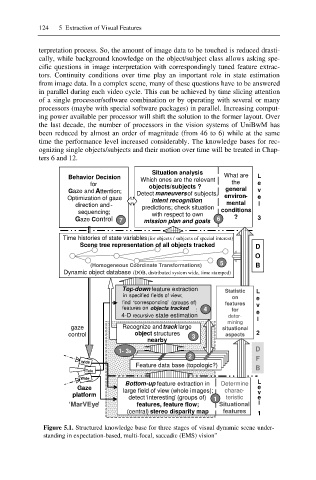
             Figure 5.1. Structured knowledge base for three stages of visual dynamic scene under-
             standing in expectation-based, multi-focal, saccadic (EMS) vision”

