


Page 145 - Dynamic Vision for Perception and Control of Motion
P. 145
5.1 Visual Features      129


            long-range, high-resolution viewing, the density of sensor elements is very high; in
            the peripheral areas added  for large angular viewing range, element  density is
            small. By this combination, a large viewing range can be combined with high reso-
            lution at least in some area with relatively moderate overall data rates. The area of
            high resolution can be shifted by active viewing direction (gaze) control by both
            the eye and the head.
               In technical systems, since inexpensive sensors are available only with homo-
            geneous pixel distributions, an equivalent mapping system is achieved by mount-
            ing two or mores cameras with lenses of different focal lengths fixed relative to
            each other on a platform. The advantage of a suite of sensors covering the same
            part of the scenery is that this part is immediately available to the system in a mul-
            ti-scale data set. If the ratio of the focal lengths is four, the image produced by the
            shorter focal length represents (coarse) information on the second pyramid level of
            the image taken with the higher resolution (larger focal length). This dual scale fac-
            tor may sometimes be advantageous in real-time vision where time delays are criti-
            cal. On  one hand, efficient  handling of  objects  requires that a sufficiently large
            number of pixels be available on each object for recognition and identification; on
            the other hand, if there are too many pixels on a single object, image processing
            becomes too involved and slow.
              As mentioned in the introduction, in complex scenes with many objects or with
            some objects with a complex pattern of sub-objects, relying solely on edge features
            may lead to difficulties and ambiguities. Combining the interpretation of edge fea-
            tures  with area-based  features (average intensity, color,  or texture)  often allows
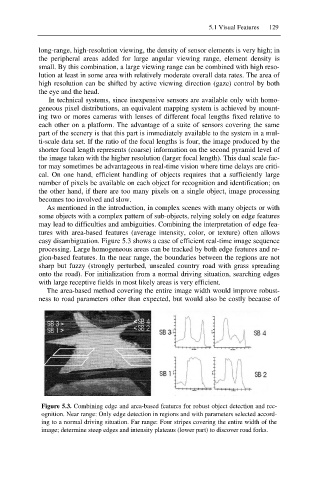
            easy disambiguation. Figure 5.3 shows a case of efficient real-time image sequence
            processing. Large homogeneous areas can be tracked by both edge features and re-
            gion-based features. In the near range, the boundaries between the regions are not
            sharp but fuzzy (strongly perturbed, unsealed country road with grass spreading
            onto the road). For initialization from a normal driving situation, searching edges
            with large receptive fields in most likely areas is very efficient.
              The area-based method covering the entire image width would improve robust-
            ness to road parameters other than expected, but would also be costly because of


             Figure 5.3. Combining edge and area-based features for robust object detection and rec-
             ognition. Near range: Only edge detection in regions and with parameters selected accord-
             ing to a normal driving situation. Far range: Four stripes covering the entire width of the
             image; determine steep edges and intensity plateaus (lower part) to discover road forks.

