


Page 149 - Dynamic Vision for Perception and Control of Motion
P. 149
5.2 Efficient Extraction of Oriented Edge Features      133


            from the mask direction or to slightly curving edges; image pixels under the zero-
            mask elements need not be touched, of course, since their weight in the mask van-
            ishes.
              For efficient computation of correlations, search direction should be either hori-
            zontal (in the y-direction, rows, dash-dotted arrow in the figure) or vertical (in the
            z-direction, columns); diagonal searches have also been used, initially, but because
            of the square-root-of-2 effect in spacing, when proceeding in diagonal search direc-
            tion, they have not gained acceptance. The wider the masks chosen, the more angu-
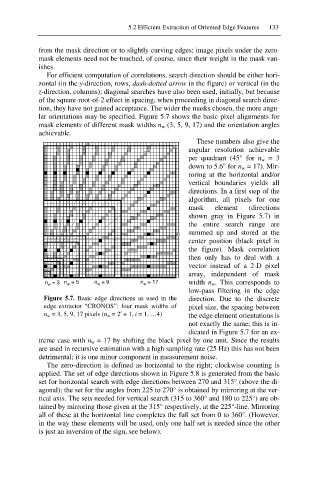
            lar orientations may be specified. Figure 5.7 shows the basic pixel alignments for
            mask elements of different mask widths n w (3, 5, 9, 17) and the orientation angles
            achievable.
                                                        These numbers also give the
                                                     angular resolution  achievable
                                                     per  quadrant (45° for  n w =  3
                                                     down to 5.6° for n w = 17). Mir-
                                                     roring at the  horizontal and/or
                                                     vertical boundaries yields all
                                                     directions. In a first step of the
                                                     algorithm, all pixels for one
                                                     mask    element  (directions
                                                     shown gray in Figure  5.7) in
                                                     the entire search  range are
                                                     summed up and stored at the
                                                     center position  (black pixel  in
                                                     the figure).  Mask correlation
                                                     then  only has to deal with a
                                                     vector instead of a 2-D pixel
                                                     array, independent  of mask
             n w = 3 n w = 5  n w = 9   n w = 17     width n w. This corresponds  to
                                                     low-pass  filtering in the edge
             Figure 5.7. Basic  edge directions as used in  the   direction.  Due to the  discrete
             edge extractor “CRONOS”: four mask widths  of   pixel size, the spacing between
                                  i
             n w  = 3, 5, 9, 17 pixels (n w  = 2  + 1, i = 1, …4)  the edge element orientations is
                                                     not exactly the same; this is in-
                                                     dicated in Figure 5.7 for an ex-
            treme case with n w = 17 by shifting the black pixel by one unit. Since the results
            are used in recursive estimation with a high sampling rate (25 Hz) this has not been
            detrimental; it is one minor component in measurement noise.
              The zero-direction is defined as horizontal to the right; clockwise counting is
            applied. The set of edge directions shown in Figure 5.8 is generated from the basic
            set for horizontal search with edge directions between 270 and 315° (above the di-
            agonal); the set for the angles from 225 to 270° is obtained by mirroring at the ver-
            tical axis. The sets needed for vertical search (315 to 360° and 180 to 225°) are ob-
            tained by mirroring those given at the 315° respectively, at the 225°-line. Mirroring
            all of these at the horizontal line completes the full set from 0 to 360°. (However,
            in the way these elements will be used, only one half set is needed since the other
            is just an inversion of the sign, see below).

