


Page 152 - Dynamic Vision for Perception and Control of Motion
P. 152
136       5  Extraction of Visual Features


            by experience in visually similar environments. From these considerations, generic
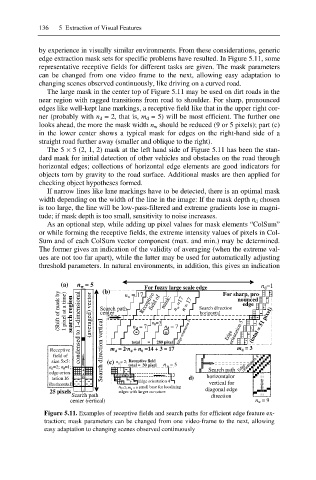
            edge extraction mask sets for specific problems have resulted. In Figure 5.11, some
            representative receptive fields for different tasks are given. The mask parameters
            can  be changed  from one  video frame to the  next, allowing easy adaptation to
            changing scenes observed continuously, like driving on a curved road.
              The large mask in the center top of Figure 5.11 may be used on dirt roads in the
            near region with ragged transitions from road to shoulder. For sharp, pronounced
            edges like well-kept lane markings, a receptive field like that in the upper right cor-
            ner (probably with n d = 2, that is, m d = 5) will be most efficient. The further one
            looks ahead, the more the mask width n w should be reduced (9 or 5 pixels); part (c)
            in the lower center shows a typical  mask for edges on the right-hand  side of a
            straight road further away (smaller and oblique to the right).
              The 5 × 5 (2, 1, 2) mask at the left hand side of Figure 5.11 has been the stan-
            dard mask for initial detection of other vehicles and obstacles on the road through
            horizontal edges; collections of horizontal edge elements are good indicators for
            objects torn by gravity to the road surface. Additional masks are then applied for
            checking object hypotheses formed.
              If narrow lines like lane markings have to be detected, there is an optimal mask
            width depending on the width of the line in the image: If the mask depth n d chosen
            is too large, the line will be low-pass-filtered and extreme gradients lose in magni-
            tude; if mask depth is too small, sensitivity to noise increases.
              As an optional step, while adding up pixel values for mask elements “ColSum”
            or while forming the receptive fields, the extreme intensity values of pixels in Col-
            Sum and of each ColSum vector component (max. and min.) may be determined.
            The former gives an indication of the validity of averaging (when the extreme val-
            ues are not too far apart), while the latter may be used for automatically adjusting
            threshold parameters. In natural environments, in addition, this gives an indication

                  (a)  n w = 5                                            n =1
                                         For fuzzy large scale edge  For sharp, pro -  d
                 (Shift of mask by   1 pixel at a time)  search region condensed to 1-dimensional  (averaged) vector  Search path  n d =7  field of  mask:  n w =17  n = 17  Search direction   nounced
                             (b)
                                         Receptive
                                    n w = 17
                                                                    edge
                                                                       (total = 51 pixel)
                             center
                                                         horizontal
                                                                       + -
                                                                       0
                                           n 0 =3
                                               n d =7
                                       -
                                               +
                                      total       =      289 pixel
               Receptive     Search direction vertical   m = 2·n + n =14 + 3 = 17 Edge orientation 5  Edge orientation 5 m d = 3
                                     d
                                        0
                                 d
                field of
               size 5×5:       (c)  n = 2; Receptive field           orientation 8
               n d =2; n 0 =1;    0  total =  30 pixel  n w = 5  Search path Edge
               edge orien-  + +   + 0 0 -
               tation16  0       +   -               d)   horizontal or
               (horizontal)  - -       Edge orientation 4  vertical for
                                  n 0=2; m d = 6 :  small base for localizing
               25 pixels          edges with larger curvature  diagonal edge
                     Search path                            direction
                     center (vertical)                                  n w = 9
             Figure 5.11. Examples of receptive fields and search paths for efficient edge feature ex-
             traction; mask parameters can be changed from one video-frame to the next, allowing
             easy adaptation to changing scenes observed continuously

