


Page 150 - Dynamic Vision for Perception and Control of Motion
P. 150
134       5  Extraction of Visual Features


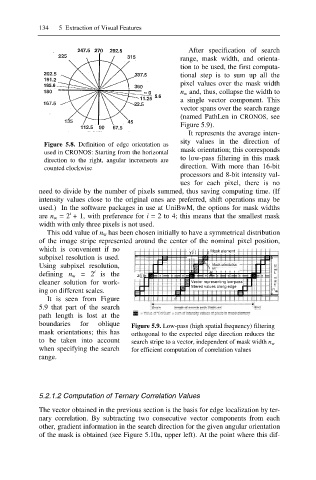
                                                     After specification  of search
                                                   range, mask width, and  orienta-
                                                   tion to be used, the first computa-
                                                   tional step is  to sum up  all the
                                                   pixel values over the mask width
             185.6
                                                   n w and, thus, collapse the width to
                                            5.6
                                                   a single vector component.  This
                                                   vector spans over the search range
                                                   (named PathLen in  CRONOS, see
                                                   Figure 5.9).
                                                     It represents the average inten-
                                                   sity values in the direction of
             Figure 5.8.  Definition  of edge orientation as
                                                   mask orientation; this corresponds
             used in CRONOS: Starting from the horizontal
                                                   to low-pass filtering in this mask
             direction to the right, angular  increments  are
             counted clockwise                     direction.  With more than 16-bit
                                                   processors and 8-bit intensity val-
                                                   ues for each  pixel, there is no
            need to divide by the number of pixels summed, thus saving computing time. (If
            intensity values close to the original ones are preferred, shift operations may be
            used.)  In the software packages in use at UniBwM, the options for mask widths
                    i
            are n w = 2 + 1, with preference for i = 2 to 4; this means that the smallest mask
            width with only three pixels is not used.
              This odd value of n w has been chosen initially to have a symmetrical distribution
            of the image stripe represented around the center  of the  nominal pixel  position,
            which is convenient if  no
                                                      y(i)  Mask element
            subpixel resolution is used.
            Using subpixel resolution,
                           i
            defining  n w = 2 is the   z(j)
            cleaner solution for  work-               Vector representing low-pass
                                                      filtered values along edge
            ing on different scales.                                         n w
              It is seen  from Figure
            5.9 that  part  of the search
            path length is lost at the
            boundaries  for  oblique  Figure 5.9. Low-pass (high spatial frequency) filtering
            mask orientations; this  has   orthogonal to the expected edge direction reduces the
            to be taken  into account
                                      search stripe to a vector, independent of mask width n w
            when specifying the search   for efficient computation of correlation values
            range.


            5.2.1.2 Computation of Ternary Correlation Values

            The vector obtained in the previous section is the basis for edge localization by ter-
            nary correlation. By subtracting two consecutive vector  components from each
            other, gradient information in the search direction for the given angular orientation
            of the mask is obtained (see Figure 5.10a, upper left). At the point where this dif-

