


Page 151 - Dynamic Vision for Perception and Control of Motion
P. 151
5.2 Efficient Extraction of Oriented Edge Features      135


            ference is largest in amplitude,   (a)  Masks characterized by: (n d      n 0      n d )
            the gradient over two consecu-
            tive  mask elements is  maxi-
                                       m d = 2;  m d = 3;       m d = 5;                           m d = 8
            mal.
                                                           m d = 17 (Total mask depth)
                                       b) (b)      7      3      7
              However, due to local  per-
            turbations, this need not corre-
                                        (c)
            spond to an actual extreme
            gradient on the scale of inter-
            est. Experience with images
            from natural environments has
            shown that two additional pa-
            rameters may  considerably
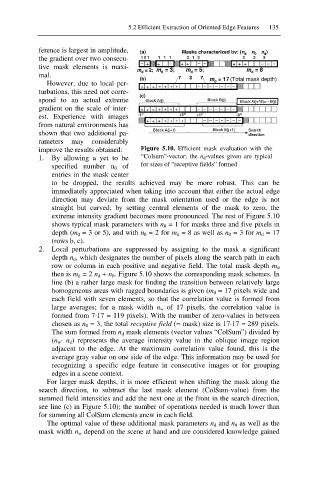
            improve the results obtained:    Figure 5.10. Efficient mask  evaluation with the
            1.  By allowing  a yet  to be   “Colsum”-vector; the  n d -values given are  typical
               specified number n 0 of   for sizes of “receptive fields” formed
               entries in the mask center
               to be dropped, the results achieved may be  more robust. This can be
               immediately appreciated when taking into account that either the actual edge
               direction may deviate from the mask orientation used  or the edge is not
               straight but curved; by setting central elements of the mask to zero, the
               extreme intensity gradient becomes more pronounced. The rest of Figure 5.10
               shows typical mask parameters with n 0 = 1 for masks three and five pixels in
               depth (m d = 3 or 5), and with n 0 = 2 for m d = 8 as well as n 0 = 3 for m d = 17
               (rows b, c).
            2.  Local perturbations are suppressed by assigning to the  mask a significant
               depth n d, which designates the number of pixels along the search path in each
               row or column in each positive and negative field. The total mask depth m d
               then is m d = 2 n d + n 0. Figure 5.10 shows the corresponding mask schemes. In
               line (b) a rather large mask for finding the transition between relatively large
               homogeneous areas with ragged boundaries is given (m d = 17 pixels wide and
               each field with seven elements, so that the correlation value is formed from
               large averages; for a mask  width  n w of  17  pixels, the correlation value is
               formed from 7·17 = 119 pixels). With the number of zero-values in between
               chosen as n 0 = 3, the total receptive field (= mask) size is 17·17 = 289 pixels.
               The sum formed from n d mask elements (vector values “ColSum”) divided by
               (n w· n d) represents the average intensity value in the  oblique image region
               adjacent to the edge.  At the  maximum correlation value found, this is the
               average gray value on one side of the edge. This information may be used for
               recognizing a  specific edge  feature in consecutive images or  for  grouping
               edges in a scene context.
              For larger mask depths, it is more efficient when shifting the mask along the
            search  direction, to subtract the last  mask element (ColSum-value) from the
            summed field intensities and add the next one at the front in the search direction,
            see line (c) in Figure 5.10); the number of operations needed is much lower than
            for summing all ColSum elements anew in each field.
              The optimal value of these additional mask parameters n d and n 0 as well as the
            mask width n w depend on the scene at hand and are considered knowledge gained

