


Page 146 - Dynamic Vision for Perception and Control of Motion
P. 146
130       5  Extraction of Visual Features


            the many pixels to be touched. Working with large receptive fields has proven to
            be reasonably reliable and efficient here. However, if computing power will allow
            color and texture processing with new area-based features, a new quality of recog-
            nition and higher robustness will result. Therefore, a compromise has been found
            that allows using some of the advantages of area-based features efficiently in con-
            nection with the 4-D approach.
              In road vehicle guidance where the viewing direction is essentially parallel to
            the ground, this method offers some advantages. Due to the scaling effect of range
            (distance x) in perspective mapping, features further away will be reduced in size;
            this may cause trouble in the interpretation process for a stereotypical application
            of pyramid-methods over larger image regions. In the upper rows, each pixel cov-
            ers a much larger distance in range than in the lower ones.
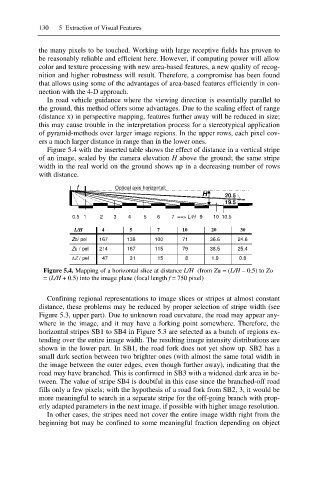
              Figure 5.4 with the inserted table shows the effect of distance in a vertical stripe
            of an image, scaled by the camera elevation H above the ground; the same stripe
            width in the real world on the ground shows up in a decreasing number of rows
            with distance.
                      f          Optical axis horizontal;
                                                         H      20.5
                                                                19.5
                     0.5   1  2  3   4   5   6   7  ==> L/H 9  10  10.5

                      L/H    4       5       7      10      20      30
                     Zo/ pel  167   136     100     71     36.6    24.6
                     Zu / pel  214  167     115     79     38.5    25.4
                     'Z / pel  47    31      15     8       1.9    0.8
             Figure 5.4. Mapping of a horizontal slice at distance L/H  (from Zu = (L/H – 0.5) to Zo
             = (L/H + 0.5) into the image plane (focal length f = 750 pixel)

              Confining regional representations to image slices or stripes at almost constant
            distance, these problems may be reduced by proper selection of stripe width (see
            Figure 5.3, upper part). Due to unknown road curvature, the road may appear any-
            where in the image, and it may have a forking point somewhere. Therefore, the
            horizontal stripes SB1 to SB4 in Figure 5.3 are selected as a bunch of regions ex-
            tending over the entire image width. The resulting image intensity distributions are
            shown in the lower part. In SB1, the road fork does not yet show up. SB2 has a
            small dark section between two brighter ones (with almost the same total width in
            the image between the outer edges, even though further away), indicating that the
            road may have branched. This is confirmed in SB3 with a widened dark area in be-
            tween. The value of stripe SB4 is doubtful in this case since the branched-off road
            fills only a few pixels; with the hypothesis of a road fork from SB2, 3, it would be
            more meaningful to search in a separate stripe for the off-going branch with prop-
            erly adapted parameters in the next image, if possible with higher image resolution.
              In other cases, the stripes need not cover the entire image width right from the
            beginning but may be confined to some meaningful fraction depending on object

