


Page 142 - Dynamic Vision for Perception and Control of Motion
P. 142
126       5  Extraction of Visual Features


            5.1.1 Introduction to Feature Extraction

            The amount of data collected by an imaging sensor is the same when looking at a
            uniformly gray region  or at a visually  complex colored scene. However, the
            amount of information perceived by an intelligent observer is considerably differ-
            ent. A human would characterize the former case exhaustively by using just three
            words: “uniformly gray”, and possibly a term specifying the gray tone (intensity).
            The statement “uniformly” may be the result of rather involved low-level parallel
            computations; but this high-level representational symbol in combination with the
            intensity value contains all the information in the image. In contrast, if several ho-
            mogeneously colored or textured subregions are being viewed, the borderlines be-
            tween these regions and the specification of the color value per region contain all
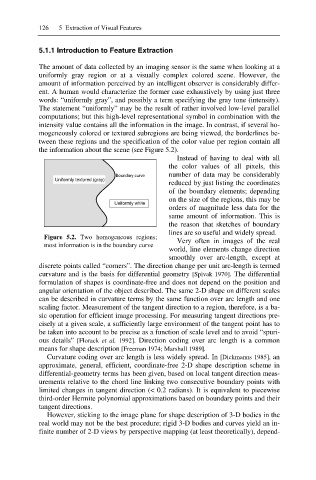
            the information about the scene (see Figure 5.2).
                                                  Instead  of having to  deal with all
                                                the color  values  of all pixels, this
                                 Boundary curve  number  of  data may be considerably
                Uniformly textured (gray)
                                                reduced by just listing the coordinates
                                                of the boundary elements; depending
                                                on the size of the regions, this may be
                                 Uniformly white
                                                orders of magnitude less data for the
                                                same amount of information. This is
                                                the reason that sketches  of  boundary
                                                lines are so useful and widely spread.
             Figure 5.2.  Two homogeneous regions;
                                                  Very often in images of the real
             most information is in the boundary curve
                                                world, line elements change direction
                                                smoothly over arc-length, except at
            discrete points called “corners”. The direction change per unit arc-length is termed
            curvature and is the basis for differential geometry [Spivak 1970]. The differential
            formulation of shapes is coordinate-free and does not depend on the position and
            angular orientation of the object described. The same 2-D shape on different scales
            can be described in curvature terms by the same function over arc length and one
            scaling factor. Measurement of the tangent direction to a region, therefore, is a ba-
            sic operation for efficient image processing. For measuring tangent directions pre-
            cisely at a given scale, a sufficiently large environment of the tangent point has to
            be taken into account to be precise as a function of scale level and to avoid “spuri-
            ous details”  [Florack et al. 1992]. Direction  coding over arc length is a  common
            means for shape description [Freeman 1974; Marshall 1989].
              Curvature coding over arc length is less widely spread. In [Dickmanns 1985], an
            approximate,  general, efficient, coordinate-free 2-D shape description scheme in
            differential-geometry terms has been given, based on local tangent direction meas-
            urements relative to the chord line linking two consecutive boundary points with
            limited changes in tangent direction (< 0.2 radians). It is equivalent to piecewise
            third-order Hermite polynomial approximations based on boundary points and their
            tangent directions.
              However, sticking to the image plane for shape description of 3-D bodies in the
            real world may not be the best procedure; rigid 3-D bodies and curves yield an in-
            finite number of 2-D views by perspective mapping (at least theoretically), depend-

