


Page 148 - Dynamic Vision for Perception and Control of Motion
P. 148
132       5  Extraction of Visual Features


            the scale range is covered by different mask sizes while the other half is handled on
            larger scales by image size reduction.
              Literature on  edge feature extraction abounds  (see,  e.g., World  Wide Web:
            http://iris.usc.edu/Vision-Notes/bibliography/contents.html; detection and  analysis
            of edges and lines (Chapter 5 there); 2-D feature analysis, extraction, and represen-
            tations (Chapter  7); Chapter 3 there gives a survey  on  books  (3.2), collections,
            overviews, and surveys).


            5.2.1 Generic Types of Edge Extraction Templates

            A substantial reason for the efficiency of the methods developed at UniBwM for
            edge feature extraction stems from the fact that both low-pass filtering in one di-
            rection and accurate search  in an almost normal direction  were combined. By
            proper partitioning of the overall task, simple but efficient pixel processing in just
            one dimension has been achieved consecutively. It is assumed that the direction of
            the edge to be found is known approximately. While this is true for tracking, it
            turned out that the algorithms are also useful for initialization if proper parameter
            settings are chosen. The software packages developed for edge extraction are gen-
            eralizations of the Prewitt operator [Ballard, Brown 1982]; they have matured over
            three generations of coding in different computer languages. The original ideas of
            Kuhnert (1988) have been refined and coded first in the second half of the 1980s in
            the language FORTRAN by Mysliwetz (1990); the current version was developed in
            the early 1990s under the name KRONOS D.Dickmanns (1997) in the language Oc-
            cam for transputers. For the next generation of processors, it has been converted to
            C under the name CRONOS and polished by S. Fuerst.

            5.2.1.1 Low-pass Filtering of an Oriented Pixel Field into a Vector

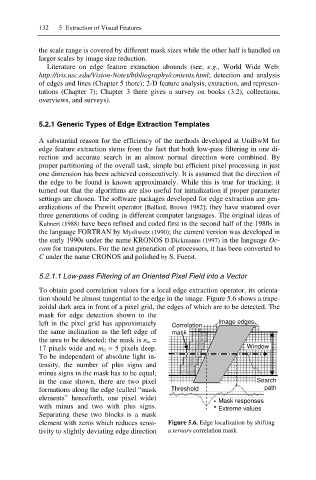
            To obtain good correlation values for a local edge extraction operator, its orienta-
            tion should be almost tangential to the edge in the image. Figure 5.6 shows a trape-
            zoidal dark area in front of a pixel grid, the edges of which are to be detected. The
            mask for edge detection shown to the
            left in the pixel grid has approximately   Correlation   Image edges
            the same inclination as the left edge of   mask
            the area to be detected; the mask is n w =
            17 pixels wide and m d = 5 pixels deep.                   Window
            To be independent of absolute light in-
            tensity, the number of plus signs and
            minus signs in the mask has to be equal;
            in the case shown, there are two  pixel                     Search
            formations along the edge (called “mask   Threshold           path
            elements” henceforth,  one pixel wide)
                                                            • Mask responses
            with minus and two  with  plus signs.           * Extreme values
            Separating these two blocks is a mask
            element with zeros which reduces sensi-  Figure 5.6. Edge localization by shifting
            tivity to slightly deviating edge direction   a ternary correlation mask

