


Page 298 - E-Bussiness and E-Commerce Management Strategy, Implementation, and Practice
P. 298
M05_CHAF9601_04_SE_C05.QXD:D01_CHAF7409_04_SE_C01.QXD  16/4/09  11:12  Page 265


                                                                                 Chapter 5 E-business strategy  265


                                                      Before the advent of e-business, many strategy process models had
                     Debate 5.1
                                                   been developed for the business strategies described above. To what
                   E-business responsibility       extent can management teams apply these models to e-business strategy
                   ‘A single person with specific e-business  development? Although strategy process models differ in emphasis and
                   responsibility is required for every  terminology, they all have common elements. Complete Activity 5.1 to
                   medium-to-large business. It is not
                                                   discuss what these common elements are.
                   sufficient for this to be the responsibility
                   of a non-specialist manager.’


                      Activity 5.1    Selecting an e-business strategy process model

                                      Purpose
                                      To identify the applicability of existing strategy process models to e-business.

                                      Activity
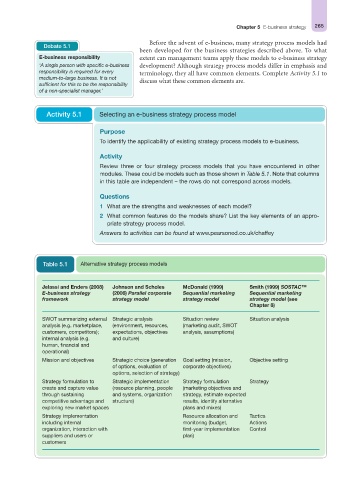
                                      Review three or four strategy process models that you have encountered in other
                                      modules. These could be models such as those shown in Table 5.1. Note that columns
                                      in this table are independent – the rows do not correspond across models.

                                      Questions
                                      1 What are the strengths and weaknesses of each model?
                                      2 What common features do the models share? List the key elements of an appro-
                                         priate strategy process model.
                                      Answers to activities can be found at www.pearsoned.co.uk/chaffey


                    Table 5.1   Alternative strategy process models


                    Jelassi and Enders (2008)  Johnson and Scholes  McDonald (1999)  Smith (1999) SOSTAC™
                    E-business strategy   (2006) Parallel corporate  Sequential marketing  Sequential marketing
                    framework             strategy model        strategy model       strategy model (see
                                                                                     Chapter 8)

                    SWOT summarizing external  Strategic analysis  Situation review  Situation analysis
                    analysis (e.g. marketplace,  (environment, resources,  (marketing audit, SWOT
                    customers, competitors);  expectations, objectives  analysis, assumptions)
                    internal analysis (e.g.  and culture)
                    human, financial and
                    operational)
                    Mission and objectives  Strategic choice (generation  Goal setting (mission,  Objective setting
                                          of options, evaluation of  corporate objectives)
                                          options, selection of strategy)
                    Strategy formulation to  Strategic implementation  Strategy formulation  Strategy
                    create and capture value  (resource planning, people  (marketing objectives and
                    through sustaining    and systems, organization  strategy, estimate expected
                    competitive advantage and  structure)       results, identify alternative
                    exploring new market spaces                 plans and mixes)
                    Strategy implementation                     Resource allocation and  Tactics
                    including internal                          monitoring (budget,  Actions
                    organization, interaction with              first-year implementation  Control
                    suppliers and users or                      plan)
                    customers

