


Page 303 - E-Bussiness and E-Commerce Management Strategy, Implementation, and Practice
P. 303
M05_CHAF9601_04_SE_C05.QXD:D01_CHAF7409_04_SE_C01.QXD  16/4/09  11:12  Page 270


                270  Part 2 Strategy and applications


                                                                     1
                                                               Strategic analysis

                                                      External                  Internal
                                                    environment                resources


                                                Techniques (Ch 4)            Techniques (Chs 5, 8)
                                                • Social                      • Resource analysis
                                                • Legal and ethical           • Portfolio analysis
                                                • Economic                    • SWOT analysis
                                                • Political                   • Demand analysis
                                                • Technological               • Competitor analysis


                                                          E-business specific techniques
                                                      • Stage models of e-business development
                                           • Assessing sell-side, buy-side and value-network opportunities and threats


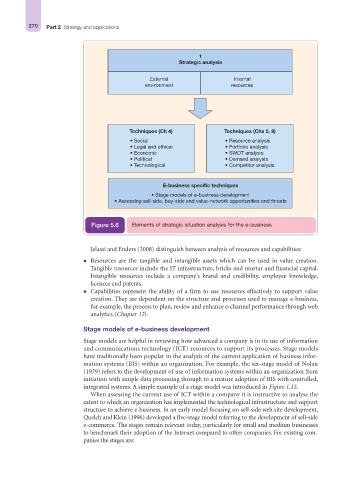
                                    Figure 5.6  Elements of strategic situation analysis for the e-business


                                   Jelassi and Enders (2008) distinguish between analysis of resources and capabilities:
                                   Resources are the tangible and intangible assets which can be used in value creation.
                                   Tangible resources include the IT infrastructure, bricks and mortar and financial capital.
                                   Intangible resources include a company’s brand and credibility, employee knowledge,
                                   licences and patents.
                                   Capabilities represent the ability of a firm to use resources effectively to support value
                                   creation. They are dependent on the structure and processes used to manage e-business,
                                   for example, the process to plan, review and enhance e-channel performance through web

                                   analytics (Chapter 12).

                                 Stage models of e-business development
                                 Stage models are helpful in reviewing how advanced a company is in its use of information
                                 and communications technology (ICT) resources to support its processes. Stage models
                                 have traditionally been popular in the analysis of the current application of business infor-
                                 mation systems (BIS) within an organization. For example, the six-stage model of Nolan
                                 (1979) refers to the development of use of information systems within an organization from
                                 initiation with simple data processing through to a mature adoption of BIS with controlled,
                                 integrated systems. A simple example of a stage model was introduced in Figure 1.13.
                                   When assessing the current use of ICT within a company it is instructive to analyse the
                                 extent to which an organization has implemented the technological infrastructure and support
                                 structure to achieve e-business. In an early model focusing on sell-side web site development,
                                 Quelch and Klein (1996) developed a five-stage model referring to the development of sell-side
                                 e-commerce. The stages remain relevant today, particularly for small and medium businesses
                                 to benchmark their adoption of the Internet compared to other companies. For existing com-
                                 panies the stages are:

