


Page 306 - E-Bussiness and E-Commerce Management Strategy, Implementation, and Practice
P. 306
M05_CHAF9601_04_SE_C05.QXD:D01_CHAF7409_04_SE_C01.QXD  16/4/09  11:12  Page 273


                                                                                 Chapter 5 E-business strategy  273


                                                            High potential                Strategic
                                                              (Beware)                    (Attack)

                                        of      High    • •  Electronic catalogue   • •  Procurement system
                                                          E-commerce system
                                        importance  systems  •  Customer intelligence  •  Distribution systems
                                                                                     Stock control system
                                                          and CRM systems

                                        strategic  information


                                                              Support
                                        Future  Low     •  HR systems                  Key operational
                                                               (Safe)
                                                                                          (Explore)
                                                        •  Finance systems          •  Production line systems


                                                               Low                         High


                                                                   Current strategic importance of
                                                                       information systems

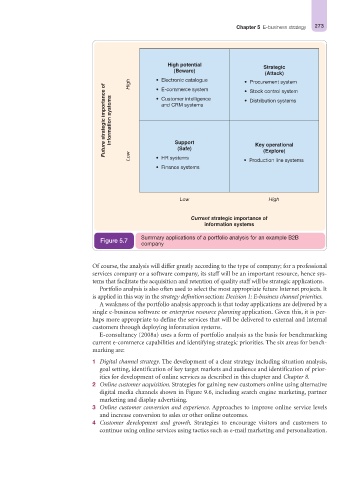
                                                   Summary applications of a portfolio analysis for an example B2B
                                      Figure 5.7
                                                   company

                                    Of course, the analysis will differ greatly according to the type of company; for a professional
                                    services company or a software company, its staff will be an important resource, hence sys-
                                    tems that facilitate the acquisition and retention of quality staff will be strategic applications.
                                      Portfolio analysis is also often used to select the most appropriate future Internet projects. It
                                    is applied in this way in the strategy definition section: Decision 1: E-business channel priorities.
                                      A weakness of the portfolio analysis approach is that today applications are delivered by a
                                    single e-business software or enterprise resource planning application. Given this, it is per-

                                    haps more appropriate to define the services that will be delivered to external and internal
                                    customers through deploying information systems.
                                      E-consultancy (2008a) uses a form of portfolio analysis as the basis for benchmarking
                                    current e-commerce capabilities and identifying strategic priorities. The six areas for bench-
                                    marking are:
                                    1 Digital channel strategy. The development of a clear strategy including situation analysis,
                                      goal setting, identification of key target markets and audience and identification of prior-
                                      ities for development of online services as described in this chapter and Chapter 8.
                                    2 Online customer acquisition. Strategies for gaining new customers online using alternative
                                      digital media channels shown in Figure 9.6, including search engine marketing, partner
                                      marketing and display advertising.
                                    3 Online customer conversion and experience. Approaches to improve online service levels
                                      and increase conversion to sales or other online outcomes.
                                    4 Customer development and growth. Strategies to encourage visitors and customers to
                                      continue using online services using tactics such as e-mail marketing and personalization.

