


Page 305 - E-Bussiness and E-Commerce Management Strategy, Implementation, and Practice
P. 305
M05_CHAF9601_04_SE_C05.QXD:D01_CHAF7409_04_SE_C01.QXD  16/4/09  11:12  Page 272


                272  Part 2 Strategy and applications


                                 through transactional e-commerce. In fact, stage models could be developed for a range of
                                 different types of online presence and business models each with different objectives. In
                                 Chapter 1, we identified the four major different types of online presence for marketing: (1)
                                 transactional e-commerce site, (2) services-oriented relationship-building web site, (3)
                                 brand-building site and (4) portal or media site. A stage model for increasing sophistication
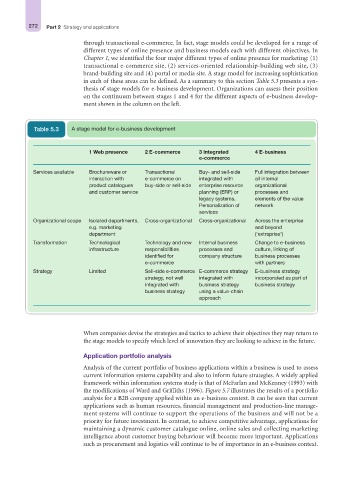
                                 in each of these areas can be defined. As a summary to this section Table 5.3 presents a syn-
                                 thesis of stage models for e-business development. Organizations can assess their position
                                 on the continuum between stages 1 and 4 for the different aspects of e-business develop-
                                 ment shown in the column on the left.


                  Table 5.3  A stage model for e-business development


                                   1 Web presence   2 E-commerce     3 Integrated      4 E-business
                                                                     e-commerce

                 Services available  Brochureware or  Transactional  Buy- and sell-side  Full integration between
                                   interaction with  e-commerce on   integrated with   all internal
                                   product catalogues  buy-side or sell-side  enterprise resource  organizational
                                   and customer service              planning (ERP) or  processes and
                                                                     legacy systems.   elements of the value
                                                                     Personalization of  network
                                                                     services
                 Organizational scope  Isolated departments,  Cross-organizational  Cross-organizational  Across the enterprise
                                   e.g. marketing                                      and beyond
                                   department                                          (‘extraprise’)
                 Transformation    Technological    Technology and new  Internal business  Change to e-business
                                   infrastructure   responsibilities  processes and    culture, linking of
                                                    identified for   company structure  business processes
                                                    e-commerce                         with partners
                 Strategy          Limited          Sell-side e-commerce E-commerce strategy  E-business strategy
                                                    strategy, not well  integrated with  incorporated as part of
                                                    integrated with  business strategy  business strategy
                                                    business strategy  using a value-chain
                                                                     approach


                                 When companies devise the strategies and tactics to achieve their objectives they may return to
                                 the stage models to specify which level of innovation they are looking to achieve in the future.

                                 Application portfolio analysis
                                 Analysis of the current portfolio of business applications within a business is used to assess
                                 current information systems capability and also to inform future strategies. A widely applied
                                 framework within information systems study is that of McFarlan and McKenney (1993) with
                                 the modifications of Ward and Griffiths (1996). Figure 5.7 illustrates the results of a portfolio
                                 analysis for a B2B company applied within an e-business context. It can be seen that current
                                 applications such as human resources, financial management and production-line manage-
                                 ment systems will continue to support the operations of the business and will not be a
                                 priority for future investment. In contrast, to achieve competitive advantage, applications for
                                 maintaining a dynamic customer catalogue online, online sales and collecting marketing
                                 intelligence about customer buying behaviour will become more important. Applications
                                 such as procurement and logistics will continue to be of importance in an e-business context.

