


Page 307 - E-Bussiness and E-Commerce Management Strategy, Implementation, and Practice
P. 307
M05_CHAF9601_04_SE_C05.QXD:D01_CHAF7409_04_SE_C01.QXD  16/4/09  11:12  Page 274


                274  Part 2 Strategy and applications


                                 5 Cross-channel integration and brand development. Integrating online sales and service with
                                   customer communications and service interactions in physical channels such as traditional
                                   advertising, phone and in-store touchpoints.
                                 6 Digital channel governance. Issues in managing e-commerce services such as structure and
                                   resourcing including human resources and the technology infrastructure such as hardware
                                   and networking facilities to deliver these applications.

                                 Organizational and IS SWOT analysis
               SWOT analysis     SWOT analysis is a relatively simple yet powerful tool that can help organizations analyse
               Strengths, weaknesses,  their internal resources in terms of strengths and weaknesses and match them against the
               opportunities and threats.
                                 external environment in terms of opportunities and threats. In an e-business context, a
                                 SWOT analysis of e-business-specific issues can combine SWOT related to corporate, market-
                                 ing, supply chain and information systems, or a separate SWOT can be performed for each.
                                 SWOT analysis is of greatest value when it is used not only to analyse the current situation,
                                 but also as a tool to formulate strategies. To achieve this it is useful once the strengths, weak-
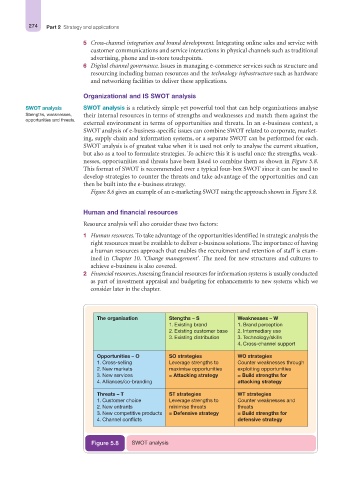
                                 nesses, opportunities and threats have been listed to combine them as shown in Figure 5.8.
                                 This format of SWOT is recommended over a typical four-box SWOT since it can be used to
                                 develop strategies to counter the threats and take advantage of the opportunities and can
                                 then be built into the e-business strategy.
                                   Figure 8.6 gives an example of an e-marketing SWOT using the approach shown in Figure 5.8.


                                 Human and financial resources
                                 Resource analysis will also consider these two factors:
                                 1 Human resources. To take advantage of the opportunities identified in strategic analysis the
                                   right resources must be available to deliver e-business solutions. The importance of having
                                   a human resources approach that enables the recruitment and retention of staff is exam-
                                   ined in Chapter 10, ‘Change management’. The need for new structures and cultures to
                                   achieve e-business is also covered.
                                 2 Financial resources.Assessing financial resources for information systems is usually conducted
                                   as part of investment appraisal and budgeting for enhancements to new systems which we
                                   consider later in the chapter.


                                     The organisation       Stengths – S          Weaknesses – W
                                                            1. Existing brand     1. Brand perception
                                                            2. Existing customer base  2. Intermediary use
                                                            3. Existing distribution  3. Technology/skills
                                                                                  4. Cross-channel support
                                     Opportunities – O      SO strategies         WO strategies
                                     1. Cross-selling       Leverage strengths to  Counter weaknesses through
                                     2. New markets         maximise opportunities  exploiting opportunities
                                     3. New services        = Attacking strategy  = Build strengths for
                                     4. Alliances/co-branding                     attacking strategy

                                     Threats – T            ST strategies         WT strategies
                                     1. Customer choice     Leverage strengths to  Counter weaknesses and
                                     2. New entrants        minimise threats      threats
                                     3. New competitive products  = Defensive strategy  = Build strengths for
                                     4. Channel conflicts                         defensive strategy


                                    Figure 5.8  SWOT analysis

