


Page 301 - E-Bussiness and E-Commerce Management Strategy, Implementation, and Practice
P. 301
M05_CHAF9601_04_SE_C05.QXD:D01_CHAF7409_04_SE_C01.QXD  16/4/09  11:12  Page 268


                268  Part 2 Strategy and applications


                                 timescale, organizations naturally also need an emergent process to enable strategic agility
                                 (introduced in Chapter 2) and the ability to rapidly respond to marketplace dynamics.
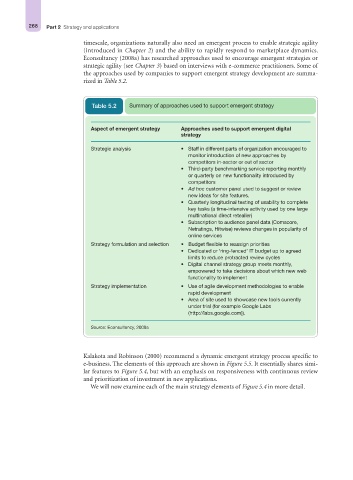
                                 Econsultancy (2008a) has researched approaches used to encourage emergent strategies or
                                 strategic agility (see Chapter 3) based on interviews with e-commerce practitioners. Some of
                                 the approaches used by companies to support emergent strategy development are summa-
                                 rized in Table 5.2.


                                    Table 5.2   Summary of approaches used to support emergent strategy


                                   Aspect of emergent strategy  Approaches used to support emergent digital
                                                                strategy
                                   Strategic analysis           • Staff in different parts of organization encouraged to
                                                                  monitor introduction of new approaches by
                                                                  competitors in-sector or out of sector
                                                                • Third-party benchmarking service reporting monthly
                                                                  or quarterly on new functionality introduced by
                                                                  competitors
                                                                • Ad hoc customer panel used to suggest or review
                                                                  new ideas for site features.
                                                                • Quarterly longitudinal testing of usability to complete
                                                                  key tasks (a time-intensive activity used by one large
                                                                  multinational direct reteailer)
                                                                • Subscription to audience panel data (Comscore,
                                                                  Netratings, Hitwise) reviews changes in popularity of
                                                                  online services
                                   Strategy formulation and selection  • Budget flexible to reassign priorities
                                                                • Dedicated or ‘ring-fenced’ IT budget up to agreed
                                                                  limits to reduce protracted review cycles
                                                                • Digital channel strategy group meets monthly,
                                                                  empowered to take decisions about which new web
                                                                  functionality to implement
                                   Strategy implementation      • Use of agile development methodologies to enable
                                                                  rapid development
                                                                • Area of site used to showcase new tools currently
                                                                  under trial (for example Google Labs
                                                                  (http://labs.google.com)).


                                   Source: Econsultancy, 2008a


                                 Kalakota and Robinson (2000) recommend a dynamic emergent strategy process specific to
                                 e-business. The elements of this approach are shown in Figure 5.5. It essentially shares simi-
                                 lar features to Figure 5.4, but with an emphasis on responsiveness with continuous review
                                 and prioritization of investment in new applications.
                                   We will now examine each of the main strategy elements of Figure 5.4 in more detail.

