


Page 156 - Electrical Installation in Hazardous Area
P. 156
122  Electrical installations in hazardous areas


                       Because of  the degree of  uncertainty in this two safety factors need to be
                     added, one for the uncertainty in LEL  and another for the uncertainty in
                     ideal airflow. This gives:

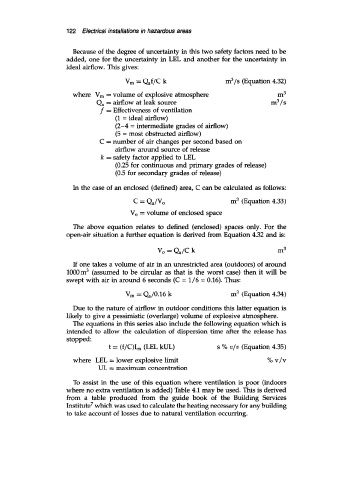
                                       V,  = Q,f/C  k                m3/s (Equation 4.32)
                       where  V,  = volume of  explosive atmosphere                  m3
                              Q,  = airflow at leak source                         m3/s
                               f = Effectiveness of  ventilation
                                    (1 = ideal airflow)
                                    (2-4  = intermediate grades of  airflow)
                                    (5 = most obstructed airflow)
                               C = number of  air changes per second based on
                                    airflow around source of  release
                                k = safety factor applied to LEL
                                    (0.25 for continuous and primary grades of  release)
                                    (0.5 for secondary grades of  release)

                       In the case of  an enclosed (defined) area, C can be calculated as follows:
                                                                       m3 (Equation 4.33)
                                         c = Q/VO
                                         Vo = volume of  enclosed space
                       The above equation relates  to  defined  (enclosed) spaces only. For  the
                     open-air situation a further equation is derived from Equation 4.32 and is:
                                                 Vo = Qa/C k                         m3

                       If  one takes a volume of  air in an unrestricted area (outdoors) of  around
                     1000m3 (assumed to be circular as that is the worst case) then it will be
                     swept with air in around 6 seconds (C = 116 = 0.16).  Thus:

                                       V,  = QJO.16  k                 m3 (Equation 4.34)

                       Due to the nature of  airflow in outdoor conditions this latter equation is
                     likely to give a pessimistic (overlarge) volume of  explosive atmosphere.
                       The equations in this series also include the following equation which is
                     intended to allow the calculation of  dispersion time after the release has
                     stopped:
                                  t = (f/C)G, (LEL kUL)            s YO v/v (Equation 4.35)
                       where  LEL = lower explosive limit                         Yo v/v
                               UL = maximum concentration

                       To  assist in the use of  this equation where ventilation is poor (indoors
                     where no extra ventilation is added) Table 4.1 may be used. This is derived
                     from  a  table  produced  from  the  guide  book  of  the  Building  Services
                     Institute7 which was used to calculate the heating necessary for any building
                     to take account of  losses due to natural ventilation occurring.

