


Page 151 - Electrical Installation in Hazardous Area
P. 151
Calculation of release rates and extents  1 17

                  the leak path. In these circumstances the basic equation remains as Equa-
                  tion 4.13 but atmospheric pressure is replaced by P,  where P,  is 0.55 x the
                  saturated  vapour  pressure of  the contained liquid at operating tempera-
                  ture  of  the  process. This may  not,  of  course, be  the  same as the  actual
                  containment pressure, which may be higher if  additional external means of
                  pressurization are used but such is not normally the case - the maintenance
                  of the material as liquid being secured by its own vapour pressure acting
                  upon the containment. In addition, the density of  the released mixture of
                  combined liquid and vapour  is the composite of  the two elements of  the
                  mixture. Thus:

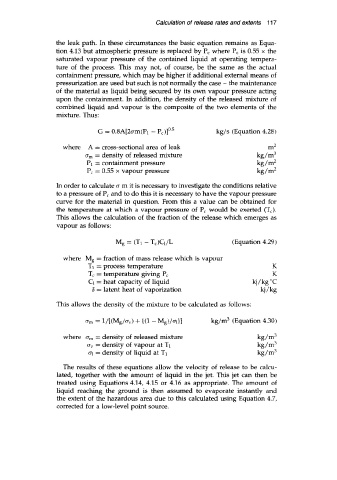
                               G = 0.8A[2am(P1 - P,)]o.5          kg/s (Equation 4.28)

                    where  A = cross-sectional area of  leak
                           am = density of  released mixture
                           P1 = containment pressure
                           P,  = 0.55 x vapour pressure

                  In order to calculate a m it is necessary to investigate the conditions relative
                  to a pressure of  P,  and to do this it is necessary to have the vapour pressure
                  curve for the material in question. From this a value can be obtained for
                  the temperature at which a vapour pressure of  P,  would be exerted (T,).
                  This allows the calculation of  the fraction of  the release which emerges as
                  vapour as follows:


                    where  M,  = fraction of  mass release which is vapour
                           TI = process temperature                                K
                            T,  = temperature giving P,                            K
                            CI = heat capacity of  liquid                    kj / kg "C
                             6 = latent heat of  vaporization                   kj/kg

                  This allows the density of  the mixture to be calculated as follows:


                    where  am = density of  released mixture
                           a, = density of  vapour at TI
                            01  = density of  liquid at T1
                    The results of  these equations allow the velocity of  release to be calcu-
                  lated, together with the amount of  liquid in  the jet. This jet  can then be
                  treated  using Equations 4.14, 4.15 or  4.16 as appropriate. The amount of
                  liquid  reaching  the  ground  is  then  assumed  to  evaporate instantly and
                  the extent of  the hazardous area due to this calculated using Equation 4.7,
                  corrected for a low-level point source.

