


Page 146 - Electrical Installation in Hazardous Area
P. 146
1 12  Electrical installations in hazardous areas


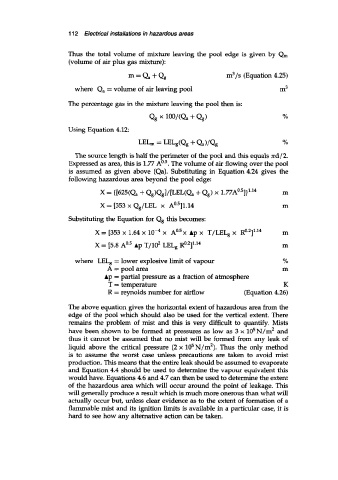
                      Thus the total volume of  mixture leaving the pool edge is given by  Q,,,
                      (volume of  air plus gas mixture):
                                        m=Q,+Qg                       m3/s (Equation  4.25)

                        where  Q, = volume of  air leaving pool                       m3

                      The percentage gas in the mixture leaving the pool then is:
                                              Q,  x lOO/(Q, + Q,)                      %

                      Using Equation 4.12:
                                           LEL, = LELg(Qg + Qa)/Qg                     %
                        The source length is half  the perimeter of  the pool and this equals rrd/2.
                      Expressed as area, this is 1.77 A0.5. The volume of air flowing over the pool
                      is  assumed as given above (Qa). Substituting in  Equation 4.24 gives the
                      following hazardous area beyond the pool edge:
                                                                         0.5  1.14
                               X = WWQ, + Q,)Q,I/[LEL(Q,  + Q,)   x 1.VA  11          m
                               X = [353 x Q,/LEL  x  Ao.5]1.14                        m
                      Substituting the Equation for Qg this becomes:

                              X = [353 x 1.64 x   x  A0.5x Ap x  T/LEL,  x  Ro.2]1.14   m

                              X = [5.8    Ap T/ld LEL,  Ro.2]1.14                     m
                        where  LEL,  = lower explosive limit of  vapour                %
                                 A = pool area                                        m
                                 Ap  = partial pressure as a fraction of  atmosphere
                                  T = temperature                                      K
                                  R = reynolds number for airflow          (Equation  4.26)

                      The above equation gives the horizontal extent of  hazardous area from the
                      edge of  the pool which should also be used for the vertical extent. There
                      remains the problem of  mist  and this is very  difficult to  quantify. Mists
                      have been shown to be  formed at pressures as low as 3 x 1@N/m2 and
                      thus it cannot be  assumed that no mist will be formed from any leak of
                      liquid above the critical pressure  (2 x 1@N/m2). Thus the  only method
                      is  to  assume the  worst  case unless precautions are taken to  avoid mist
                      production. This means that the entire leak should be assumed to evaporate
                      and Equation 4.4 should be used to determine the vapour equivalent this
                      would have. Equations 4.6 and 4.7 can then be used to determine the extent
                      of  the hazardous area which will occur around the point of  leakage. This
                      will generally produce a result which is much more onerous than what will
                      actually occur but, unless clear evidence as to the extent of  formation of  a
                      flammable mist and its ignition limits is available in a particular case, it is
                     hard to see how any alternative action can be taken.

