


Page 142 - Electrical Installation in Hazardous Area
P. 142
108  Electrical installations in hazardous areas

                     Thus:

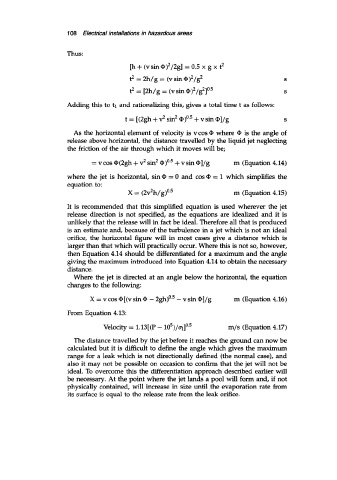
                                        [h + (v sin @)’/2g] = 0.5 x g x ?
                                        t2 = zh/g = (vsin@)’/$                         S
                                        t2 =      = (v sin @)*/$10.5                   S

                     Adding this to tl and rationalizing this, gives a total time t as follows:

                                       t = [(Zgh + V2 sin’ @)O.’  + v sin @]/g         S
                       As the horizontal element of  velocity is vcos  where @ is the angle of
                     release above horizontal, the distance travelled by the liquid jet neglecting
                     the friction of  the air through which it moves will be;

                             = v cos @(2gh + V2 sin2 @)0.5 + v sin @]/g   m (Equation 4.14)

                     where the jet  is horizontal, sin @ = 0 and  cos @ = 1 which simplifies the
                     equation to:
                                        x = (2~2h/~)0.5                 m (Equation 4.15)
                     It is recommended that this simplified equation is used wherever the jet
                     release direction is not specified, as the equations are idealized and it is
                      unlikely that the release will in fact be ideal. Therefore all that is produced
                     is an estimate and, because of  the turbulence in a jet which is not an ideal
                     orifice, the horizontal figure will in most cases give a  distance which is
                     larger than that which will practically occur. Where this is not so, however,
                      then Equation 4.14 should be differentiated for a maximum and the angle
                      giving the maximum introduced into Equation 4.14 to obtain the necessary
                      distance.
                       Where the jet is directed at an angle below the horizontal, the equation
                      changes to the following:

                                                       -
                            x =  cos     sin @ - ~~hy3.5 sin @]/g       m (Equation 4.16)
                     From Equation 4.13:

                                 Velocity = 1.13[(P - 105)/q]0.5      m/s (Equation 4.17)

                        The distance travelled by the jet before it reaches the ground can now be
                      calculated but it is difficult to define the angle which gives the maximum
                      range for a leak which is not directionally defined (the normal case), and
                      also it may not be possible on occasion to confirm that the jet will not be
                      ideal. To  overcome this the differentiation approach described earlier will
                     be necessary. At the point where the jet lands a pool will form and, if not
                      physically contained, will increase in size until the evaporation rate from
                      its surface is equal to the release rate from the leak orifice.

