


Page 140 - Electrical Installation in Hazardous Area
P. 140
1 06  Electrical installations in hazardous areas


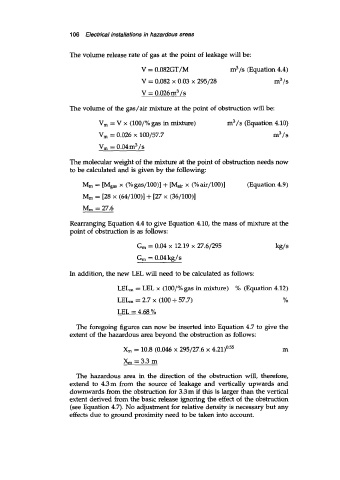
                      The volume release rate of  gas at the point of  leakage will be:
                                            V = 0.082GT/M              m3/s (Equation 4.4)

                                            V = 0.082 x 0.03 x 295/28               m3/s
                                            V = 0.026 m3/s

                      The volume of  the gas/air mixture at the point of  obstruction will be:
                               V,  = V x (100/Y0 gas in mixture)      m3/s (Equation 4.10)

                               V,  = 0.026 x 100/57.7                               m3/s
                               Vm = 0.04m3/s

                      The molecular weight of  the mixture at the point of  obstruction needs now
                      to be calculated and is given by the following:
                          M,  = [Mgas x (%gas/100)] + [M& x (%air/100)]     (Equation 4.9)
                          M,  = [28 x (64/100)] + [27 x (36/100)]

                          Mm  = 27.6

                      Rearranging Equation 4.4 to give Equation 4.10, the mass of  mixture at the
                      point of  obstruction is as follows:

                                           G,  = 0.04 x 12.19 x 27.6/295
                                           Gm  = 0.04 kg/s

                      In addition, the new LEL will need to be calculated as follows:

                                     LEL,  = LEL x (100/%gas in mixture)  YO  (Equation 4.12)
                                     LEL,  = 2.7 x (100 + 57.7)                        YO

                                     LEL = 4.68 Yo
                        The foregoing figures can now be inserted into Equation 4.7 to give the
                      extent of  the hazardous area beyond the obstruction as follows:

                                       X,  = 10.8 (0.046 x 295127.6 x 4.21)0.55        m
                                       Xm = 3.3 m

                        The hazardous  area  in the direction of  the  obstruction will,  therefore,
                      extend to 4.3m  from the  source of  leakage and  vertically upwards  and
                      downwards from the obstruction for 3.3m if  this is larger than the vertical
                      extent derived from the basic release ignoring the effect of  the obstruction
                      (see Equation 4.7). No adjustment for relative density is necessary but any
                      effects due to ground proximity need to be taken into account.

