


Page 136 - Electrical Installation in Hazardous Area
P. 136
102  Electrical installations in hazardous areas


                         10
                         7
                         5
                         3
                         2

                         1
                        0.7
                        0.5
                        0.3
                        0.2


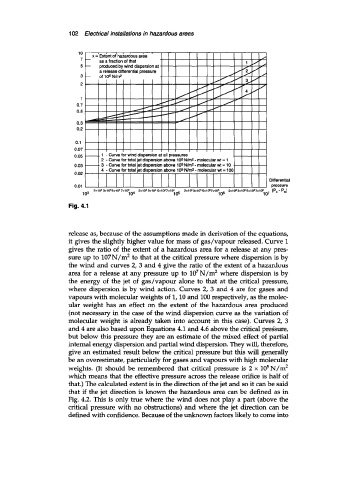
                        0.05  -.   1 - Curve for wind dispersion at all pressures
                                2 - Curve for total jet dispersion above 105 N/m* - molecular wt = 1
                        0.03  -.   3 - Curve for total jet dispersion above 105 N/m2 - molecular wt = 10
                                4  - Curve for total jet dispersion above 105 N/m2- molecular wt = 100
                        0.02  -
                                                                                   Differential
                        0.01                                                       pressure


                      release as, because of  the assumptions made in derivation of  the equations,
                      it gives the slightly higher value for mass of  gas/vapour  released. Curve 1
                      gives the ratio of  the extent of  a hazardous area for a release at any pres-
                      sure up to 107N/m2 to that at the critical pressure where dispersion is by
                      the wind and curves 2,3 and 4 give the ratio of  the extent of  a hazardous
                      area for a release at any pressure up to 107N/m2 where dispersion is by
                      the energy of  the jet  of  gas/vapour  alone to that  at the critical pressure,
                      where dispersion is by wind  action. Curves 2,  3 and 4 are for gases and
                      vapours with molecular weights of  1/10 and 100 respectively, as the molec-
                      ular  weight has  an effect on the extent of  the hazardous  area produced
                      (not necessary in the case of  the wind dispersion curve as the variation of
                      molecular weight is already taken into account in this case). Curves 2,  3
                      and 4 are also based upon Equations 4.1 and 4.6 above the critical pregsure,
                      but below this pressure they are an estimate of  the mixed effect of  partial
                      internal energy dispersion and partial wind dispersion. They will, therefore,
                      give an estimated result below the critical pressure but this will generally
                      be an overestimate, particularly for gases and vapours with high molecular
                      weights. (It should be remembered that critical pressure is 2 x 10⁵N/m2
                      which means that the effective pressure across the release orifice is half  of
                      that.) The calculated extent is in the direction of  the jet and so it can be said
                      that if  the jet direction is known the hazardous area can be defined as in
                      Fig. 4.2.  This is only true where the wind does not play a part (above the
                      critical pressure with no obstructions) and where the jet  direction can be
                      defined with confidence. Because of  the unknown factors likely to come into

