


Page 137 - Electrical Installation in Hazardous Area
P. 137
Calculation of  release rates and extents  103


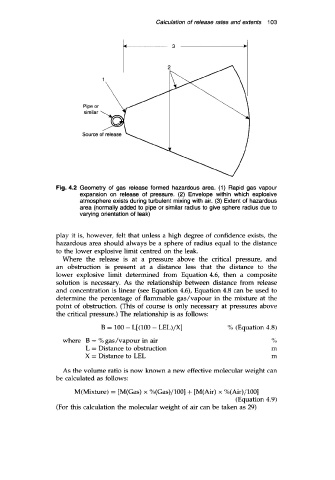
                  Fig. 4.2  Geometry of  gas  release formed  hazardous area.  (1)  Rapid gas vapour
                         expansion  on  release of  pressure. (2)  Envelope  within  which  explosive
                         atmosphere exists during turbulent mixing with air. (3) Extent of  hazardous
                         area (normally added to pipe or similar radius to give sphere radius due to
                         varying orientation of  leak)


                  play it is, however, felt that unless a high degree of  confidence exists, the
                  hazardous area should always be a sphere of  radius equal to the distance
                  to the lower explosive limit centred on the leak.
                    Where  the  release  is  at  a  pressure  above  the  critical  pressure,  and
                  an  obstruction  is  present  at  a  distance  less  that  the  distance  to  the
                  lower  explosive  limit  determined  from  Equation 4.6,  then  a  composite
                  solution is  necessary. As  the  relationship between distance from release
                  and concentration is linear (see Equation 4.6), Equation 4.8 can be used to
                  determine the percentage of  flammable gas/vapour  in the mixture at the
                  point of  obstruction. (This of  course is only necessary at pressures above
                  the critical pressure.) The relationship is as follows:

                                B = 100 - L[(100 - LEL)/X]            o/o  (Equation 4.8)
                    where  B = %gas/vapour  in air                                 m
                                                                                   O/O
                           L = Distance to obstruction
                           X = Distance to LEL                                     m

                    As the volume ratio is now known a new effective molecular weight can
                  be calculated as follows:

                       M(Mixture)  = [M(Gas) x %(Gas)/100] + [M(Air) x %(Air)/100]
                                                                        (Equation 4.9)
                  (For this calculation the molecular weight of  air can be taken as 29)

