


Page 147 - Electrical Installation in Hazardous Area
P. 147
Calculation of release rates and extents  1 13

                  4.2.1 Example of liquid release below its atmospheric boiling point

                  Example 3

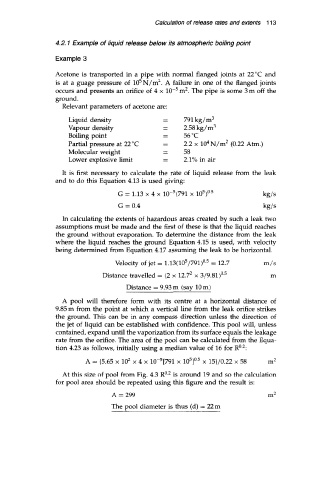
                  Acetone is transported in a pipe with normal flanged joints at 22°C and
                  is at a guage pressure of  105N/m2.  A  failure in one of  the flanged joints
                  occurs and presents an orifice of  4 x   m2. The pipe is some 3 m off  the
                  ground.
                    Relevant parameters of  acetone are:

                      Liquid density              =     791kg/m3
                     Vapour density               =     2.58kg/m3
                      Boiling point               =     56°C
                     Partial pressure at 22 "C    =     2.2 x 10⁴N/m2 (0.22 Atm.)
                     Molecular weight             =     58
                     Lower explosive limit        =     2.1% in air

                    It  is first necessary to calculate the rate of  liquid release from the leak
                  and to do this Equation 4.13 is used giving:

                                    G = 1.13 x 4 x 10-5(791 x 105)0-5           kg/s
                                    G = 0.4                                     kgls
                    In calculating the extents of  hazardous areas created by such a leak two
                  assumptions must be made and the first of these is that the liquid reaches
                  the ground without evaporation. To  determine the distance from the leak
                  where the liquid reaches the ground Equation 4.15 is used, with velocity
                  being determined from Equation 4.17 assuming the leak to be horizontal.

                                    Velocity of  jet = 1.13(105/791)0.5 = 12.7   m/s
                                Distance travelled = (2 x 12.7'  x 3/9.81)0.5      m
                                       Distance = 9.93m (say 10m)

                    A pool  will  therefore form with  its  centre at  a  horizontal distance of
                  9.85m from the point at which a vertical line from the leak orifice strikes
                  the ground. This can be  in any compass direction unless the direction of
                  the jet of  liquid can be established with confidence. This pool will, unless
                  contained, expand until the vaporization from its surface equals the leakage
                  rate from the orifice. The area of  the pool can be calculated from the Equa-
                  tion 4.23 as follows, initially using a median value of  16 for Ro.2:
                           A = (5.65 x 10'  x 4 x 10⁻⁵[791 x 105]0.5 x 15}/0.22 x 58   m2

                    At this size of  pool from Fig. 4.3 R0.'  is around 19 and so the calculation
                  for pool area should be repeated using this figure and the result is:

                                   A = 299                                        m2
                                   The pool diameter is thus (d) = 22m

