


Page 192 - Electrical Installation in Hazardous Area
P. 192
156  Electrical installations in hazardous areas


                     may  occur  during the  normal  operation  of  the  plant.  Again,  these  are
                     synonymous in derivation with their gas and vapour counterparts and are
                     not expected to be present for more than 10 per cent of  the time. Typical of
                     such releases are the interior of  some process vessels and loading points,
                     and access doors to dust processing vessels or transport systems.


                     Secondary grade sources of  release

                     Secondary Grade Sources of  Release  are  those  which  are not  normally
                     expected to release except in abnormal operation, such as the failure of
                     extract filters and similar situations.


                     6.2.2 Definition of Zones

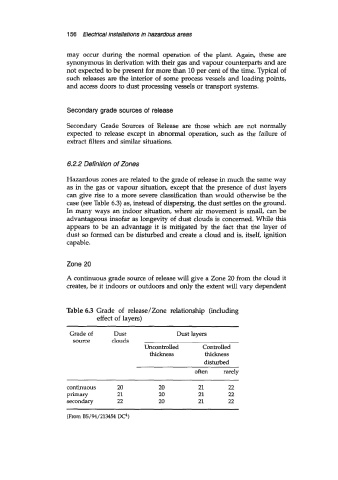
                     Hazardous zones are related to the grade of  release in much the same way
                     as in the gas or vapour situation, except that the presence of  dust layers
                     can give rise to a more severe classification than would otherwise be the
                     case (see Table 6.3) as, instead of  dispersing, the dust settles on the ground.
                     In many ways an indoor situation, where air movement is small, can be
                     advantageous insofar as longevity of  dust clouds is concerned. While this
                     appears to be  an advantage it is mitigated by  the fact that the layer  of
                     dust so formed can be disturbed and mate a cloud and is, itself, ignition
                     capable.


                     Zone 20

                     A continuous grade source of  release will give a Zone 20 from the cloud it
                     creates, be it indoors or outdoors and only the extent will vary dependent


                     Table 6.3 Grade  of  release/Zone  relationship  (including
                              effect of  layers)
                      Grade of     Dust               Dust layers
                       source      clouds
                                             Uncontrolled     Controlled
                                              thickness        thickness
                                                               disturbed
                                                            often    rarely

                     continuous     20           20          21       22
                     Primary        21           20          21       22
                     secondary      22           20          21       22

                     (From BS/94/213454 LX4)

