


Page 196 - Electrical Installation in Hazardous Area
P. 196
160  Electrical installations in hazardous areas


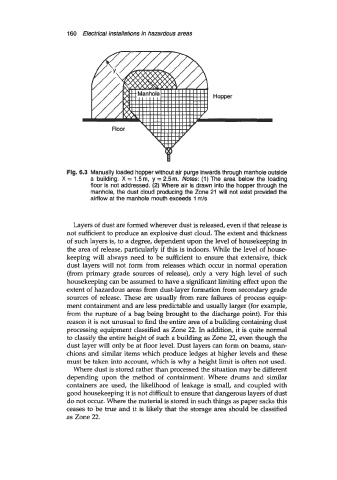
                     Fig. 6.3  Manually loaded hopper without air purge inwards through manhole outside
                            a  building. X = 1.5m, y = 2.5m.  Notes: (1) The  area  below  the  loading
                            floor is not addressed. (2) Where air is drawn into the hopper through the
                            manhole, the dust cloud producing the Zone 21 will  not exist provided the
                            airflow at the manhole mouth exceeds 1 m/s


                       Layers of  dust are formed wherever dust is released, even if  that release is
                     not sufficient to produce an explosive dust cloud. The extent and thickness
                     of  such layers is, to a degree, dependent upon the level of  housekeeping in
                     the area of  release, particularly if  this is indoors. While the level of  house-
                     keeping will always need  to be  sufficient to ensure that extensive, thick
                     dust layers will not form from releases which occur in normal operation
                     (from primary grade sources of  release), only a very  high level of  such
                     housekeeping can be assumed to have a signhcant limiting effect upon the
                     extent of  hazardous areas from dust-layer formation from secondary grade
                     sources of  release. These are usually from rare failures of  process equip-
                     ment containment and are less predictable and usually larger (for example,
                     from the rupture of  a bag being brought to the discharge point). For this
                     reason it is not unusual to find the entire area of  a building containing dust
                     processing equipment classified as Zone 22. In addition, it is quite normal
                     to classlfy the entire height of  such a building as Zone 22, even though the
                     dust layer will only be at floor level. Dust layers can form on beams, stan-
                     chions and similar items which produce ledges at higher levels and these
                     must be taken into account, which is why a height limit is often not used.
                       Where dust is stored rather than processed the situation may be different
                     depending upon  the  method  of  containment. Where  drums and  similar
                     containers are used,  the likelihood of  leakage is small, and coupled with
                     good housekeeping it is not difficult to ensure that dangerous layers of  dust
                     do not occur. Where the material is stored in such things as paper sacks this
                     ceases to be true and it is likely that the storage area should be classified
                     as Zone 22.

