


Page 299 - Electronic Commerce
P. 299
Chapter 6

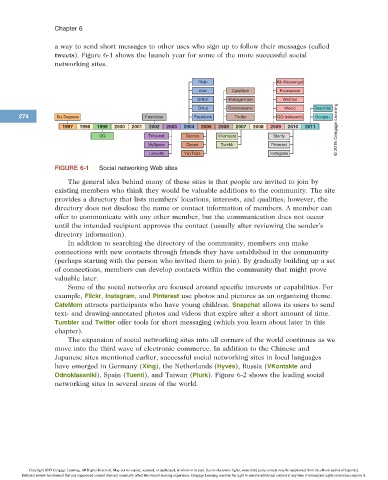
                a way to send short messages to other uses who sign up to follow their messages (called
                tweets). Figure 6-1 shows the launch year for some of the more successful social
                networking sites.


                                                       Flickr                Kik Messenger
                                                        mixi     CafeMom      Foursquare
                                                        mixi
                                                       GREE     Mobage-town   WeChat
                                                                Mobage-town
                                                       Orkut   Odnoklassniki   Weibo   Snapchat
      274        Six Degrees             Friendster   Facebook   Twitter     QQ (relaunch)  Google+  Learning
                                                                                             Cengage
                  1997  1998  1999  2000  2001  2002  2003  2004  2005  2006  2007  2008  2009  2010  2011
                            QQ            Tribe.net  Renren  VKontakte      Storify
                                                                                             2015
                                          MySpace   Qzone    Tumblr        Pinterest
                                          LinkedIn  YouTube                Instagram         ©
                FIGURE 6-1  Social networking Web sites
                    The general idea behind many of these sites is that people are invited to join by
                existing members who think they would be valuable additions to the community. The site
                provides a directory that lists members’ locations, interests, and qualities; however, the
                directory does not disclose the name or contact information of members. A member can
                offer to communicate with any other member, but the communication does not occur
                until the intended recipient approves the contact (usually after reviewing the sender’s
                directory information).
                    In addition to searching the directory of the community, members can make
                connections with new contacts through friends they have established in the community
                (perhaps starting with the person who invited them to join). By gradually building up a set
                of connections, members can develop contacts within the community that might prove
                valuable later.
                    Some of the social networks are focused around specific interests or capabilities. For
                example, Flickr, Instagram, and Pinterest use photos and pictures as an organizing theme.
                CafeMom attracts participants who have young children. Snapchat allows its users to send
                text- and drawing-annotated photos and videos that expire after a short amount of time.
                Tumbler and Twitter offer tools for short messaging (which you learn about later in this
                chapter).
                    The expansion of social networking sites into all corners of the world continues as we
                move into the third wave of electronic commerce. In addition to the Chinese and
                Japanese sites mentioned earlier, successful social networking sites in local languages
                have emerged in Germany (Xing), the Netherlands (Hyves), Russia (VKontakte and
                Odnoklassniki), Spain (Tuenti), and Taiwan (Plurk). Figure 6-2 shows the leading social
                networking sites in several areas of the world.


         Copyright 2015 Cengage Learning. All Rights Reserved. May not be copied, scanned, or duplicated, in whole or in part. Due to electronic rights, some third party content may be suppressed from the eBook and/or eChapter(s).
       Editorial review has deemed that any suppressed content does not materially affect the overall learning experience. Cengage Learning reserves the right to remove additional content at any time if subsequent rights restrictions require it.

