


Page 305 -
P. 305
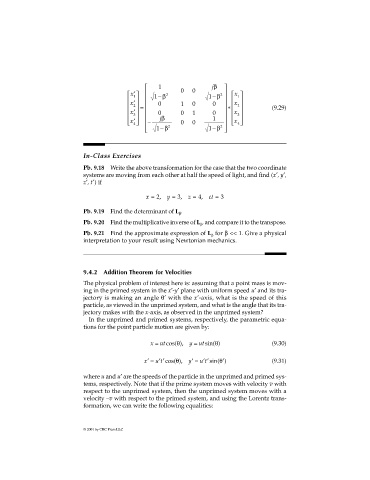
1 jβ
x 1 ′ 1 − β 2 0 0 1 − β 2 x 1
′ x 2 = 0 1 0 0 ∗ x 2 (9.29)
x ′ 0 0 1 0 x 3
3
jβ 1
x
4 ′ x − 0 0 4
1 − β 2 1 − β 2
In-Class Exercises
Pb. 9.18 Write the above transformation for the case that the two coordinate
systems are moving from each other at half the speed of light, and find (x′, y′,
z′, t′) if
x = 2, y = 3, z = 4, ct = 3
Pb. 9.19 Find the determinant of L .
β
Pb. 9.20 Find the multiplicative inverse of L , and compare it to the transpose.
β
Pb. 9.21 Find the approximate expression of L for β << 1. Give a physical
β
interpretation to your result using Newtonian mechanics.
9.4.2 Addition Theorem for Velocities
The physical problem of interest here is: assuming that a point mass is mov-
ing in the primed system in the x′-y′ plane with uniform speed u′ and its tra-
jectory is making an angle θ′ with the x′-axis, what is the speed of this
particle, as viewed in the unprimed system, and what is the angle that its tra-
jectory makes with the x-axis, as observed in the unprimed system?
In the unprimed and primed systems, respectively, the parametric equa-
tions for the point particle motion are given by:
x = utcos( ),θ y = utsin( )θ (9.30)
u
u
x ′ = ′′ t cos( ),θ y ′ = ′′ t sin(θ ′) (9.31)
where u and u′ are the speeds of the particle in the unprimed and primed sys-
tems, respectively. Note that if the prime system moves with velocity v with
respect to the unprimed system, then the unprimed system moves with a
velocity –v with respect to the primed system, and using the Lorentz trans-
formation, we can write the following equalities:
© 2001 by CRC Press LLC

