


Page 309 -
P. 309
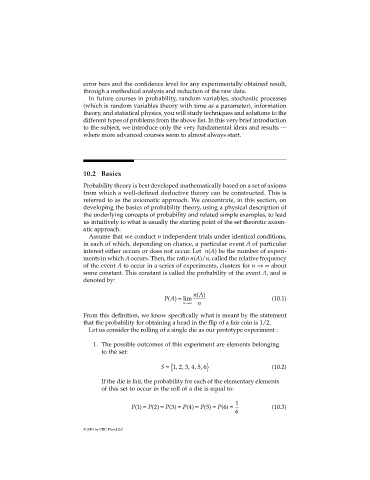
error bars and the confidence level for any experimentally obtained result,
                             through a methodical analysis and reduction of the raw data.
                              In future courses in probability, random variables, stochastic processes
                             (which is random variables theory with time as a parameter), information
                             theory, and statistical physics, you will study techniques and solutions to the
                             different types of problems from the above list. In this very brief introduction
                             to the subject, we introduce only the very fundamental ideas and results —
                             where more advanced courses seem to almost always start.


                             10.2 Basics

                             Probability theory is best developed mathematically based on a set of axioms
                             from which a well-defined deductive theory can be constructed. This is
                             referred to as the axiomatic approach. We concentrate, in this section, on
                             developing the basics of probability theory, using a physical description of
                             the underlying concepts of probability and related simple examples, to lead
                             us intuitively to what is usually the starting point of the set theoretic axiom-
                             atic approach.
                              Assume that we conduct n independent trials under identical conditions,
                             in each of which, depending on chance, a particular event A of particular
                             interest either occurs or does not occur. Let  n(A) be the number of experi-
                             ments in which A occurs. Then, the ratio n(A)/n, called the relative frequency
                             of the event A to occur in a series of experiments, clusters for n →∞ about
                             some constant. This constant is called the probability of the event A, and is
                             denoted by:

                                                                 nA()
                                                       PA( ) =  lim                        (10.1)
                                                              n→∞  n
                             From this definition, we know specifically what is meant by the statement
                             that the probability for obtaining a head in the flip of a fair coin is 1/2.
                              Let us consider the rolling of a single die as our prototype experiment :
                                1. The possible outcomes of this experiment are elements belonging
                                   to the set:

                                                      S = {12 3 4 5 6,,, ,,  }             (10.2)

                                   If the die is fair, the probability for each of the elementary elements
                                   of this set to occur in the roll of a die is equal to:

                                                                               1
                                             P()1 =  P( )2 =  P( )3 =  P( )4 =  P( )5 =  P( )6 =  (10.3)
                                                                               6

                             © 2001 by CRC Press LLC

