


Page 312 -
P. 312
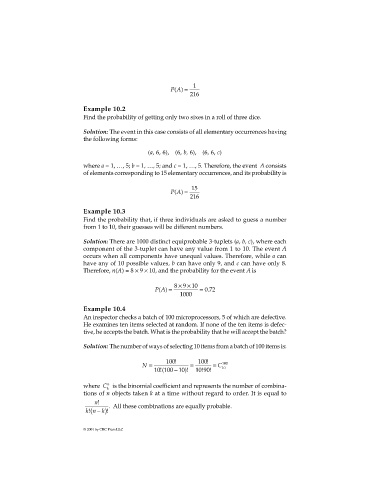
PA() =  1
                                                                216

                             Example 10.2
                             Find the probability of getting only two sixes in a roll of three dice.

                             Solution: The event in this case consists of all elementary occurrences having
                             the following forms:

                                                  (a, 6, 6),  (6, b, 6),  (6, 6, c)

                             where a = 1, …, 5; b = 1, …, 5; and c = 1, …, 5. Therefore, the event  A consists
                             of elements corresponding to 15 elementary occurrences, and its probability is


                                                         PA() =  15
                                                                216

                             Example 10.3
                             Find the probability that, if three individuals are asked to guess a number
                             from 1 to 10, their guesses will be different numbers.

                             Solution: There are 1000 distinct equiprobable 3-tuplets (a, b, c), where each
                             component of the 3-tuplet can have any value from 1 to 10. The event A
                             occurs when all components have unequal values. Therefore, while a can
                             have any of 10 possible values, b can have only 9, and c can have only 8.
                             Therefore, n(A) = 8 × 9 × 10, and the probability for the event A is

                                                            ×× 10
                                                    PA() =  89     =  . 072
                                                             1000

                             Example 10.4
                             An inspector checks a batch of 100 microprocessors, 5 of which are defective.
                             He examines ten items selected at random. If none of the ten items is defec-
                             tive, he accepts the batch. What is the probability that he will accept the batch?

                             Solution: The number of ways of selecting 10 items from a batch of 100 items is:

                                                N =     100!    =  100!  =  C 100
                                                    10 100!(  − 10)!  10 90!  !  10

                             where  C n   is the binomial coefficient and represents the number of combina-
                                    k
                             tions of n objects taken k at a time without regard to order. It is equal to
                                n!
                             kn k!(  −  ! )  .   All these combinations are equally probable.


                             © 2001 by CRC Press LLC

