


Page 316 -
P. 316
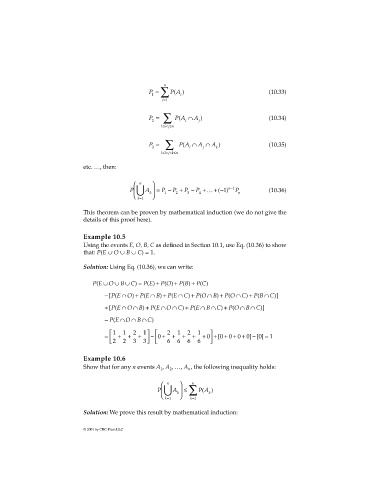
1 ∑
P = n P A( i ) (10.33)
=
i 1
2 ∑
P = P A ∩( i A ) (10.34)
j
1≤< ≤
ij n
3 ∑
P = P A ∩( i A ∩ A ) (10.35)
j
k
1≤< < ≤
ij k n
etc. …, then:
n
P U A k = P − P + P − P +…+ −1( ) n−1 P n (10.36)
2
1
4
3
k=1
This theorem can be proven by mathematical induction (we do not give the
details of this proof here).
Example 10.5
Using the events E, O, B, C as defined in Section 10.1, use Eq. (10.36) to show
that: P(E ∪ O ∪ B ∪ C) = 1.
Solution: Using Eq. (10.36), we can write:
PE ( ∪ O ∪ ∪ C) = P E ( ) + P O) + P B ( ) + P C ( )
B
(
− [ PE ( ∩ O) + P E ( ∩ B) + PE ( ∩ C) + P O ∩ B) + P O ∩ C) + P B ( ∩ C)]
(
(
+ [ PE ( ∩ O ∩ B) + PE ( ∩ O ∩ C) + PE ( ∩ ∩ C) + P O ∩ ∩ C)]
(
B
B
− PE ( ∩ O ∩ BB ∩ C)
= 1 + 1 + 2 + 3 1 − 0 + 2 + 6 1 + 2 + 1 + 0 + [0000 − = 1
+++ ] [ ]0
6
2
2
3
6
6
Example 10.6
Show that for any n events A , A , …, A , the following inequality holds:
n
2
1
n n
≤
P U A k ∑ P A( k )
k=1 k=1
Solution: We prove this result by mathematical induction:
© 2001 by CRC Press LLC

