


Page 319 -
P. 319
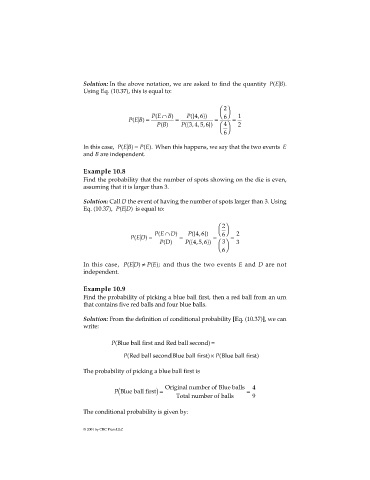
Solution: In the above notation, we are asked to find the quantity PEB( ).
Using Eq. (10.37), this is equal to:
2
PE ( ∩ B) P({ , }) 6 1
46
PEB) = = = =
(
345 6
PB () P({ , , , }) 4 2
6
In this case, PEB( ) = P E( ). When this happens, we say that the two events E
and B are independent.
Example 10.8
Find the probability that the number of spots showing on the die is even,
assuming that it is larger than 3.
Solution: Call D the event of having the number of spots larger than 3. Using
Eq. (10.37), PED( ) is equal to:
2
PE( ∩ D) P({ , }) 6 2
46
PED( ) = = = =
PD() P({ , , }) 3 3
45 6
6
In this case, PED( ) ≠ P E( ); and thus the two events E and D are not
independent.
Example 10.9
Find the probability of picking a blue ball first, then a red ball from an urn
that contains five red balls and four blue balls.
Solution: From the definition of conditional probability [Eq. (10.37)], we can
write:
P(Blue ball first and Red ball second) =
P(Red ball secondBlue ball first) × P(Blue ball first)
The probability of picking a blue ball first is
(
P Blue ball first) = Original number of Blue balls = 4
Total number of balls 9
The conditional probability is given by:
© 2001 by CRC Press LLC

