


Page 322 -
P. 322
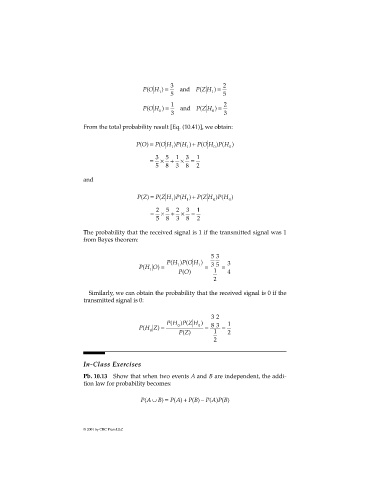
PO H(  ) =  3  and  P Z H(  ) =  2
                                                      1                1
                                                         5                 5
                                                PO H(  ) =  1  and  P Z H(  ) =  2
                                                      0                0
                                                          3                3
                             From the total probability result [Eq. (10.41)], we obtain:

                                              PO() =  PO H P H(  ) (  ) +  P O H P H(  ) (  )
                                                          1    1        0    0
                                                   =  3  ×  5  +  1  ×  3  =  1
                                                     5  8  3  8   2
                             and


                                              PZ() =  PZ H P H(  ) (  ) +  P Z H P H(  ) (  )
                                                          1    1        0    0
                                                   =  2  ×  5  +  2  ×  3  =  1
                                                     5  8  3   8  2

                             The probability that the received signal is 1 if the transmitted signal was 1
                             from Bayes theorem:

                                                                       5 3
                                                        PH P O H(  ) (  )   3
                                               PH O(  ) =   1      1  =  3 5  =
                                                   1                    1
                                                            PO()            4
                                                                        2
                              Similarly, we can obtain the probability that the received signal is 0 if the
                             transmitted signal is 0:


                                                                       3 2
                                                        PH P Z H(  0 ) (  0  )  1
                                               PH Z(  ) =            =  8 3  =
                                                   0                    1
                                                            PZ()            2
                                                                        2


                             In-Class Exercises
                             Pb. 10.13 Show that when two events A and B are independent, the addi-
                             tion law for probability becomes:

                                                PA( ∪ B) = P A() +  P B( ) −  P A P B() ( )


                             © 2001 by CRC Press LLC

