


Page 320 -
P. 320
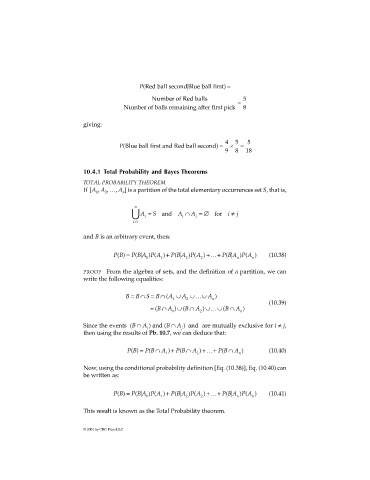
P(Red ball secondBlue ball first) =

                                                   Number of Red balls           5
                                                                                =
                                          Number of balls remaining after first pick  8

                             giving:


                                         P(Blue ball first and Red ball second) =  4  ×  5  =  5
                                                                            9  8  18


                             10.4.1 Total Probability and Bayes Theorems
                             TOTAL PROBABILITY THEOREM
                             If  [A , A , …, A ] is a partition of the total elementary occurrences set S, that is,
                                 1
                                    2
                                          n
                                              n
                                             U A =  S and   A ∩  A = ∅ for  i ≠  j
                                                             i
                                                                  j
                                                 i
                                             i=1
                             and B is an arbitrary event, then:

                                       PB() =  PB A P A(  ) (  ) +  P B A P A(  ) (  ) +…+  PB A P A(  ) (  )  (10.38)
                                                 1    1       2    2           n    n

                             PROOF From the algebra of sets, and the definition of a partition, we can
                             write the following equalities:

                                           B =  B ∩ =  B ∩ ( A ∪ A ∪…∪  A )
                                                 S
                                                          1    2       n
                                                                                          (10.39)
                                                            = ( B ∩  A ∪)  ( B ∩  A ∪…∪)  ( B ∩  A )
                                                          1        2            n
                             Since the events  (B ∩  A  ) and ( B ∩  A  )   and  are mutually exclusive for i ≠ j,
                                                  i          j
                             then using the results of Pb. 10.7, we can deduce that:

                                           PB() =  PB( ∩ A ) + P B( ∩ A ) +…+  PB( ∩  A )  (10.40)
                                                        1         2             n

                             Now, using the conditional probability definition [Eq. (10.38)], Eq. (10.40) can
                             be written as:

                                       PB() =  PB A P A(  ) (  ) +  P B A P A(  ) (  ) +…+  PB A P A(  ) (  )  (10.41)
                                                 1    1       2    2           n    n

                             This result is known as the Total Probability theorem.


                             © 2001 by CRC Press LLC

