


Page 315 -
P. 315
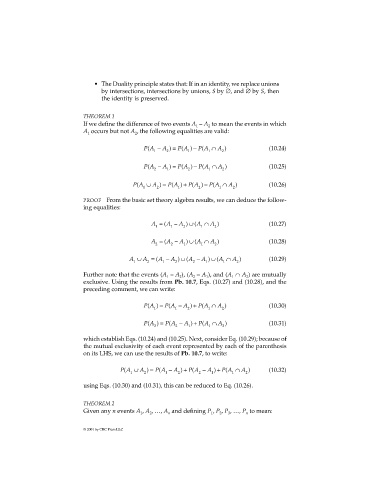
• The Duality principle states that: If in an identity, we replace unions
                                   by intersections, intersections by unions, S by ∅, and ∅ by S, then
                                   the identity is preserved.


                             THEOREM 1
                             If we define the difference of two events A  – A  to mean the events in which
                                                                      2
                                                                  1
                             A  occurs but not A , the following equalities are valid:
                                              2
                              1
                                                 PA(  −  A ) =  P A(  ) −  P A(  ∩  A )   (10.24)
                                                    1   2      1      1   2
                                                 PA(  − A ) =  P A(  ) −  P A(  ∩  A )    (10.25)
                                                    2   1      2      1    2

                                             PA(  ∪ A ) =  P A(  ) +  P A(  ) −  P A(  ∩  A )  (10.26)
                                                1    2      1      2      1   2
                             PROOF From the basic set theory algebra results, we can deduce the follow-
                             ing equalities:


                                                   A = ( A −  A ∪)  ( A ∩  A )            (10.27)
                                                     1   1    2    1    2
                                                   A = ( A −  A ∪)  ( A ∩  A )            (10.28)
                                                    2     2   1     1   2
                                            A ∪  A = ( A −  A ∪)  ( A −  A ∪)  ( A ∩  A )  (10.29)
                                             1    2    1   2     2   1     1   2
                             Further note that the events (A  – A ), (A  – A ), and (A ∩ A ) are mutually
                                                                              1
                                                                                  2
                                                                     1
                                                        1
                                                            2
                                                                 2
                             exclusive. Using the results from Pb. 10.7, Eqs. (10.27) and (10.28), and the
                             preceding comment, we can write:
                                                 PA(  ) =  PA(  − A ) +  P A(  ∩  A )     (10.30)
                                                    1      1   2      1   2
                                                 PA(  ) =  PA(  −  A ) +  P A(  ∩  A )    (10.31)
                                                    2      2   1      1    2
                             which establish Eqs. (10.24) and (10.25). Next, consider Eq. (10.29); because of
                             the mutual exclusivity of each event represented by each of the parenthesis
                             on its LHS, we can use the results of Pb. 10.7, to write:


                                         PA(  ∪ A ) =  P A(  − A ) +  PA(  − A ) +  P A(  ∩  A )  (10.32)
                                            1    2      1   2      2   1      1   2
                             using Eqs. (10.30) and (10.31), this can be reduced to Eq. (10.26).


                             THEOREM 2
                             Given any n events A , A , …, A  and defining P , P , P , …, P  to mean:
                                                                          2
                                                                             3
                                                                                  n
                                                         n
                                                   2
                                                                       1
                                               1
                             © 2001 by CRC Press LLC

